social media management services

Setting Your Social Media Up For Success In Quarter 4

While you may not be quite ready to buy your Halloween costume or deck the halls with boughs of holly, now is the time to start planning your holiday and quarter 4 strategy for your business. Quarter 4 lasts from October to December and finishes out the year. This means that you will be covering 3 major holidays with Halloween, Thanksgiving, and Christmas. If you are a product or inventory based company you will be counting on this quarter to implement up-to-date social media management services to be your most profitable and make up for some of the profits that may have been lost due to the coronavirus. It is also always good to end the year on a high note to start off the new year on a good foot.

We all know 2020 has not only been physically and emotionally tough due to the coronavirus but it has also been financially tough due to job layoffs, unemployment, and shutdowns. While many businesses are trying to figure out how to bring back sales, many people are losing hope and are looking ahead to better times. There is a lot of uncertainty as we approach the 4th quarter. There is still hope that the 4th quarter can be your strongest quarter if you take action now. There are many ways to use social media marketing to plan and execute your quarter 4 strategy as well as increase your brand awareness and sales.

Social Media Marketing Benefits And Features To Promote Your Business For The Holiday Season

One of the most beneficial ways for product and merchandise providers to capitalize on the upcoming holiday season is by utilizing Facebook Shop. Facebook Shop allows users to directly shop and browse your inventory directly on Facebook. This is a great way to shop online as people do not have to risk going into the stores and can conveniently do it safely at home through their Facebook account. Facebook shops are relatively easy to set up as well and oftentimes are easier than selling products on a website page or online shopping company such as Amazon. All you need as a seller to create a Facebook Shops site is a Facebook account and a Facebook business page as well as a valid bank account and tax identification number. Facebook shops allow anyone who likes your page or is visiting your page to quickly browse your product inventory available directly through Facebook instead of having to click through another website to access your inventory. For users looking to buy gifts for the upcoming holiday season, this is perfect to quickly access and purchase gifts for their loved ones and receive them before the holiday rush begins.

Another very beneficial social media feature that can be very beneficial for product and merchandising clients is Shoppable Pinterest Pins. Similar to Facebook Shop, Shoppable Pinterest Pins allow you to showcase your product and inventory that is available for purchase much quicker than going to a separate website. This is convenient for users who are searching for gift ideas on Pinterest. Having a Shoppable Pinterest Pin set up will allow the users to directly click on the pin and order the product with just a simple click. An added bonus to steering up and using Shoppable Pinterest Pins right now is that many users are already starting to look for holiday ideas and gifts on Pinterest. In fact, some of the largest trending items on Pinterest this summer were holiday and gift ideas for 2020. Even though we are still months away from Christmas, the coronavirus has helped build up the hype for the holiday season. Showcasing your inventory and making your products available now with Pinterest Shoppable Pins and Facebook Shop will allow you to capitalize and sell to the audience who is already searching for gifts and put you ahead of the competition that waits to make their holiday products and inventory available.

You may also find that increasing your ad spend for the holiday season is a wise move. Oftentimes many companies utilize paid advertisements and increase their spending in the 4th quarter. This can make ad space more competitive. However, by increasing your ad spend you will stay above the competition and gain that ad space that is so vital during this time. The 4th quarter is when consumers spend the most money. Increasing your ad spend will allow you to take advantage of this additional spend. Many people are also paying more attention to ads as they are looking for gifts and ideas for the holiday season. 

Contact Us About Our Social Media Management Services To Market Your Business Today

Using these two social media features and increasing your ad spend will allow you to showcase your inventory and products as well as increase your profits and sales for the holiday season and the 4th quarter. While coronavirus has been very financially devastating to many companies, there is still hope for those who take action now and plan ahead. Let’s get ready to spread that holiday cheer for this upcoming holiday season! When it comes to our social media management services, if you would like to take advantage of Facebook Shop or Shoppable Pinterest Pins we can help you! At The AD Leaf ®, we have a team of Social Media Specialists who thrive off of cultivating premium content and paid ads for a variety of businesses. Give us a call at (321) 255-0900 or, set up a consultation by emailing us at info@theadleaf.com. We look forward to making your 4th quarter and holiday season a success!

Content Marketing For Nonprofits

The Ins and Outs of Content Marketing for Nonprofits

If you run or are involved in a nonprofit, you know how important advertising is in order to get the word of your organization out to the proper channels. However, determining what medium you want to advertise in can be tricky to figure out. Nonprofits require constant communication between volunteers, donors, and those interested in your organization’s activities. Not only that, but your nonprofit also has to reach people in your community or even beyond to gain interest from them. That is why you should consider content marketing for nonprofits as a major form of your marketing strategy. As we are currently living in a time where togetherness is more crucial than ever, consider these important things when deciding whether you should begin writing content for your organization.

Content is a Broad Term

When you think about content writing, what do you think of? Website pages? Social media posts? How about blogs, brochures, emails, and other forms of communication? 

Well, the good news is that all of this is considered content, and its production is considered content writing. From there, you can determine groups for volunteers and employees to be split into. Perhaps one group can work on improving your company’s website content, while another can draft some posts for Facebook.  

The Magic of Search Engine Optimization

You have probably heard of the term “SEO” before, but are unaware of what exactly it means. Search Engine Optimization, or SEO for short, refers to the increasing of your website’s status on search engines such as Google. This can be done in a number of different ways, but most notably through the usage of important keywords that will notify search engines of your page. The more important keywords that are on your website, the higher your website will be in organic search results. 

Content Shows Your Authenticity

Chances are that, at some point in your life, you were scammed out of something. It is a real bummer, but when it comes to nonprofit scams, it can quickly go from bothersome to illegal. That is why showing your credentials on your website and social media platforms is so important. Uploading credentials such as your 501(c)(3) tax-exempt status to your website shows that you are a legitimate nonprofit that your audience can trust. 

Content Ideas to Get You Started

The AD Leaf Marketing Firm LLC has created a list of easy, simple ideas for content to help you get started with optimizing your nonprofit using content writing:

  • Creating a Donations page for your contributors to donate to
  • Starting a blog about your day-to-day operations
  • Fleshing out an About section that includes your organization’s mission statement
  • Writing about your programs and initiatives for separate pages

Need more ideas? Want to take the content marketing for nonprofits to the next level? Give The AD Leaf Marketing Firm LLC a call today at 321-255-0900 for more information and to schedule a free consultation.

Do You Hear the People e-Sing?

If you’re like me, you entered 2020 with a pretty full concert calendar. Excited for the artists both young and old I’d be seeing, I had even been planning weekend getaways to correspond with some of the shows. Obviously, those plans came to a bit of a halt with the onset of coronavirus. Music fans around the world were left sad and lost at the prospect of at least a year without a show to let loose at. Enter a new music industry line: the social e-concert thanks to Social Media Marketing for TikTok and other platforms. 

The concept of live-streaming an event is certainly nothing new but up until this point, it had been an add on to the actual live-experience. Between social distancing and different regulations in place all over tour routes, the industry had to get a bit creative. A growing number of artists are putting together live concerts for their fans that even feature their own “admission” charges. While thankfully nowhere near the same price of a standard show, this price gives you access to the concert and usually a live-chat feature with other fans– sometimes even with the artists themselves. 

Social Media Marketing for TikTokOne example of artists doing this is the band The Maine. Based out of Arizona, the band is selling $10 tickets to their concert. They’re even offering merch bundles with “tour” shirts to further make the experience feel like the real thing. Fans of the band all over social media are joining together in groups to chat and “attend” the show together. The Maine has traditionally been a band that makes great use of Social Media Marketing for TikTok and unique marketing opportunities and pandemic concerts are no exception. 
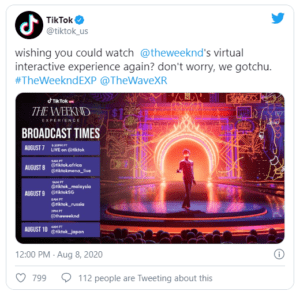
Another artist making the most of a difficult situation is The Weeknd. Real name Abel Tesfaye, The Weeknd teamed up with TikTok for the first live virtual reality concert on the app. While Abel and his avatar brought down the e-house, fans were able to chat amongst themselves and express their love for him in the comments. Social Media Marketing for TikTokTo make the experience more special, he even teased a new song and was joined for a surprise performance of a song with Doja Cat. The show was free for fans but part of the collab with the app included the release of a special collection of merch, the proceeds of which went to the Equal Justice Initiative.

Other notable artists taking part in this new era of concerts are Norah Jones, Jason Isbell, Aventura, and Post Malone, the last of which performed a tribute to Nirvana with drumming legend Travis Barker. Many are even taking the opportunity to use this time to raise money for charities or shed light on important issues. 

While the sweat and standing around at a traditional concert may not be the best part of a night out at a show, there is absolutely something to be said for the social experience it provides. Whether going with a group of friends or meeting new people there on your own, the bonding experience of a concert is an unparalleled experience. Particularly with younger people, social media provides a wonderful way to stay in touch, chat, and get excited over their favorite artists, all without having to leave the safety of their homes. 

When you think about it, while they’re certainly no replacement for the experience of a live show right in front of you, keeping the e-concert in a post-COVID world could be a great idea. These shows provide the opportunity to see a show to many who wouldn’t be able to otherwise, whether because of cost, illness, or other interference, all while still staying social, thanks to Twitter, Instagram, TikTok and other awesome social media apps. 

If you’re intrigued by the power of Social Media Marketing for TikTok and how it’s affecting the human experience during COVID, reach out to us here at The AD Leaf! We’d love to show you all social media can do for you and your company during this unprecedented time. 

The Key Differences Between Business Blogging and Professional Blogging

Blogging is a great way to utilize Content Marketing for Business and to increase traffic on your website. There are a number of different possibilities that you can use a blog for, including educating your audience about your business and promoting new ideas within your industry. 

However, some blog ideas can blur the line between professional blogging and personal blogging. Here are some of the biggest differences between these types of blogs.

Interest vs Action

One main characteristic that makes professional blogs stand out against personal blogs is the fact that its purpose is to lead its reader to take some sort of action. Personal blogs normally write to make their audiences engaged and interested in their work. However, professional blogs take this a step further. Their purpose is to engage the audience’s attention while also encouraging them to undertake some kind of big step. 

The Stories You Tell

Storytelling is arguably the main draw of blogging. Whether your blog is for your business or for yourself, you need to be able to tell some kind of story with your blog content. That being said, there is a line that must be followed when writing your blog content. When writing for your business, make sure that you are writing specifically about topics that pertain to your business. For example, a fashion store would want to write about the latest fashion trends on their blog more than what they had for lunch that day.

Flexibility

When you are writing for a personal blog, you have total control. You get to write what you want when you want. Whether this blog chronicles your day-to-day life or you talk about a broad topic such as movies or fashion, you control the decisions made. Professional blogs are not so flexible. This is because each story needs to be meticulously planned before publication. After determining what your purpose of the blog post is and whether or not the topic pertains to your company, you now need to figure out the best time and day to publish it. This can be determined using analytics for both your company website and your social media pages. If you are able to see when exactly your audience is most engaged online, figuring out when to publish your blog content will be easier than expected.

Conclusion

So, you have figured out the key differences between Content Marketing for Business vs Professional Blogs. However, you do not know where to start. No worries! The AD Leaf Marketing Firm LLC is here to get you started on your new professional blog. Give us a call at 321-255-0900 or fill out the form at the bottom of the page to schedule a free consultation today.

Marketing To Gen Z

Four Must-Have Tips for Marketing to Gen Z

According to the Pew Research Center, Generation Z is generally considered to be the generation of citizens born between 1996 and the current day. Arguably the characteristic of this generation that applies most from a marketing perspective is the fact that they are considered to be “digital natives,” which are people who have grown up in and around digital technological advancements. Their connectedness to social media and other forms of technology make them an important demographic to advertise to. However, there are some important things to consider before engaging in content writing and digital marketing to Gen Z. Here are some tips and tricks to make sure you are captivating your digital native audiences to the best of your ability.

Keep it Short and Simple

When you think of content writing, you might think about long-form blogs and website pages. However, when you’re marketing to Gen Z, understand that  has a lot of different messages being targeted at them every day, so shifting through these long and sometimes complicated content can be difficult. If you keep your message short in word count and easily digestible, you will be able to be noticed by your target audience.

Keep Track of Current Trends

In our online culture, what was once popular a week ago is considered ancient now. We have all seen those “cringe compilations” of brands that are either trying way too hard to be hip with the kids or are severely outdated. You definitely should not be including outdated memes or online trends in your content. If you see a new trend pop up in your feeds (for example, the recent “everything is a cake” meme), try to market yourself off of that as soon as possible. 

Multimedia Is Key

You simply cannot market yourself just off of promoted Twitter messages. In order to promote a consistent brand, make sure you expand into other forms of content. One idea is to convert a short blog post into a video script for social media sites such as YouTube. If your brand is able to be recognized across various forms of media, then you have succeeded in marketing to your audience. 

Do Not Bombard Your Audience

You could follow the previously mentioned tips and still find yourself lacking in engagement and sales. Why? Because you simply have done too much of it. If you frequently promote your content into the feeds of your target audience, your audience is going to get very annoyed and avoid your product rather than buy it. They might even make your frequent attempts at exposure to a meme itself.

Not Sure How to Start?

Do you want to make sure that your content is being promoted to your ideal audiences? Give The AD Leaf Marketing Firm LLC a call today at 321-255-0900 for a free consultation with our content writers, social media specialists, and more!

photos

Stock Photography: Silent Brand Killer or Time-Saver?


As a business owner, there’s a myriad of decisions that fall on your shoulders from financial decisions to branding decisions. At the end of the day, you may find yourself wanting to slap on any photos for marketing to pair with your social media posts. But before you press that “Post” button, let’s dive into the Stock Photography vs. Original Photography debate.

First things first, why can’t we simply copy and paste any photo from the world wide web? 

Avoiding Copyright Infringement

The photos that we see on online publications are copyrighted and are unable to be used for commercial and marketing use. Using these photos without the permission of the photographer, company, or publication could result in a hefty fine or further legal action. This is typically when companies look to stock photography. Let’s look at the pros and cons, shall we?


The Pro’s and Con’s of Stock Photography

Stock Photography can be a great tool to lean on when deadlines are tight. It can save you an hour’s time of messing with a camera and worrying about copyright when you just need two posts worth of photos. Sprinkling in quality stock photos to buff up your volume of content certainly won’t damage your brand credibility, however, it’s important to sift through stock photography libraries. If the image isn’t blending in with the rest of your content or branding it’ll stick out like a sore thumb. We’ve all seen those generic photos of a group of “business associates” that are giving their best faux laugh with a thumbs up. 

The last thing you want when a consumer comes across your marketing content is generic. It cancels out your credibility of providing customized customer relationships and takes away the originality of your brand that you’ve worked so hard to build. Furthermore, nothing is more embarrassing for a company than when they realize their landing page has the same smiling employee as a competitor company in another state. With the public consuming so much content in a day, you’ll be surprised at how quickly consumers of all ages can spot stock photography usage. 


The Pro’s and Con’s of Original Photography

Many business owners think that the option of original photography is an expensive and time-consuming process searching for the right photographer. Websites, such as Fiverr, are a great place to find photographers! You’ll be able to analyze their style, read reviews from past clients, and even find a product photographer for as little as $30. Think of this as a legal investment now that you’ll have complete ownership of photos that you’ll be able to use more than once. Working with a photographer will also assist in expanding your brand aesthetic that consumers can recognize without seeing your company’s name. These photos can present your service or product in your perspective. This is a part of laying down the foundation for building trust and familiarity with customers. 

Due to the majority of people having a smartphone, there’s no reason to not have photos of your product or your employees in action while they carry out a service. By typing in “Basic Smartphone Photography” on Youtube, you’ll be provided with countless quick lessons on how to take the proper photo. Allow yourself to present your own point of view and indulge in your inner creative.


Stock Photography vs. Original Photography

 In the end, your own photos for marketing will perform better than stock photography. A while back we had a client that was reluctant to provide his Social Media Specialist with photos of his employees while they were working but was unsatisfied with the performance of their social media platforms. They finally decided to send one photo and amazingly enough, the response and engagement were twice that of any previous stock imagery the Social Media Specialist has used in the past. 

A study recently conducted by “Marketing Experiments” compared the response of consumers to a stock image of a woman vs a picture of a company’s founder. Consumers were 35% more likely to sign up for a free consultation when the founder’s photo was used. Even though it wasn’t likely that visitors would be conversing with the founder, they were able to connect with a real person from the company.

All in all original photography not only saves you money in the end but is a testament to your commitment to being a trustworthy, premium content company. There’s no need to ban stock photography from your marketing content, but you’ll find the best engagement success online with photos taken by you or by a professional. 

Still intimidated by the decision on which images to use? At The AD Leaf ®, we have a team of Social Media Specialists who thrive off of cultivating premium content for a variety of businesses. Let’s work together on expanding your company’s presence online! Give us a call at (321) 255.0900 or, set up a consultation by emailing us at info@theadleaf.com. We look forward to hearing from you soon! 


Google ads campaign

Google Ads Campaign Management For Small Businesses

If you’re a small business looking to launch a Google ads campaign for your company, you may think you can’t afford this type of pay per click advertising. Alternatively, you may want to learn how to run a paid search campaign yourself which is a valuable skill to have. However, it can be time-consuming to manage campaigns while simultaneously managing your business. If you make an attempt to rush in without performing the proper research, you will probably make common beginner’s mistakes and blow your budget with nothing to show for it. This is the main reason why it is best to have a reputable digital marketing agency to handle your Google ads management for you.

Why Use Google Ads Campaigns For Your Small Business?

Reach People When They’re Looking For You

If you target the right keywords with your Google ads, you can get in front of potential customers at the exact moment they’re looking for your products. Having an ad that serves up your products on relevant keywords is a great way to get new customers.

Target Based On Your Location

If you run a local business, you don’t care about appearing in search results outside of your area. Google Ads lets you target your searches based on your location, which can help you get in front of potential customers near you.

Target Multiple Audiences That Use The Same Product

If you sell products that can appeal to multiple different audiences, Google ads can help you reach those audiences by letting you target different keywords. PPC ads would let you target each audience individually by using industry-specific keywords. For example, “Rustic coffee table” and “Western-style wooden tables” may apply to similar products, but they attract very different audiences—Google’s pay per click ads and campaigns let you target both.

Send People To Specific Landing Pages For Products/Services

When someone clicks on an ad, they get sent to a landing page on your website. One of the strengths of launching a Google ad is that you get to choose that page. A lot of people send pay per click traffic to their home page, which is ok, however, it is not ideal. But one of the major strengths of Google ads is that you can send people to your customized landing pages that are optimized to convert. By sending people to landing pages that offer what they’re looking for, you can increase your chances of converting them into customers.

Track Results Easily

With Google ads, you can track click-through rate, cost-per-click, ad spend, as well as conversion rate on your landing pages. You can also split test different ad copy and landing pages easy to maximize your ROI.  Return on investment is a huge consideration for your marketing budget, and Google ads won’t leave you guessing.

Get Results Quickly

Other approaches to getting seen in search engines can take a long time to start working. The conversion process is longer and more difficult to measure. Google ads aren’t a silver bullet, but they will get you results much faster than most other marketing tactics. If you have the know-how, products, ad copy, and landing pages together already, Google ads are a simple way to start getting sales.

Google ads and other pay per click platforms, like search engine optimization, helps companies to get their brands seen by customers searching for relevant search terms. Both of these digital marketing techniques help to increase your boost your website’s ranking so that it appears higher up on search engine result pages. Search engine optimization is a slower, long-term, organic method, whereas paid search is often a quick fix option, providing your business with a short burst of visibility which can be beneficial for temporary promotions or to publicize the launch of a new product or service.

If you require management for your Google ads campaign and looking to find a company that offers services for your small business, here are items that will be incorporated with your package below:

  • One-off set up costs
  • Regular reports and analytics
  • Fixed monthly costs
  • Optimization of existing pay per click campaigns
  • A dedicated accounts manager
  • Keyword performance and campaign monitoring
  • Budget recommendation
  • No minimum spend requirement

At The AD Leaf Marketing Firm®, we understand that not every business has the time to invest their full efforts into PPC Ads. To learn more about how Google ads campaign management can bring more leads to your business, contact us via our phone number, (321) 255.0900. Or, set up a consultation by emailing us at info@theadleaf.com. We look forward to hearing from you soon!


Are We Listening?

It’s no surprise to anyone: There are a lot of conversations going on out in the world today about many important topics and world events. There are countless important matters to discuss, and matters within matters it seems. The growing amount of high-touch topics and the availability of social media as a marketing strategy is both an exciting and somewhat sobering thing. To have so much at your fingertips is a tightrope not only for social media coordinators and marketing teams, but also for clients, businesses, and actually, anyone using social media. 

If I was to be blunt, more and more it can feel like everyone has something to say. Some opinions to give. And while this isn’t entirely bad, it isn’t entirely good, either. Taking a moment to not ignore the important issues around your brand, but to step out of the endless debates, chats, opinions, and keyboard activist to focus on a skill that needs (in my opinion) revisited: listening.

What does listening have to do with your brand? Your company? Your personal page? Your relationships? Your personal life? 


We believe a lot. 


Merriam-Webster defines listening as: “To hear something with thoughtful attention.”

To listen is to give preference to another. It is not waiting to talk. How busy are we as a brand, company, friend, or significant other with talking instead of listening? And how can listening not only help your social campaign (not to mention your life)? In the context of social media as a marketing strategy, practicing social listening can improve your brand, create community, help avoid PR nightmares, and so much more. All by listening. 

Looking at metrics and date is an invaluable practice we utilize here at The AD Leaf to see what is performing well, what could use work, to spot trends, and to develop a strategy. Some would say this is listening, but it is in fact social monitoring. Think of social monitoring as the step before you listen, or the information you are already aware of as you embark on your journey of practicing social listening. Social listening, however, is the practice of listening to what your audience is saying now. It grabs the words as it leaves your client’s mouth and takes hold of them. Look at them. Analyze them. And then use them as valuable pieces of information for them. Let me illustrate.

Apple for the longest time has been known as a brand who is well…stubborn. They have a long-standing habit of being very exclusive, private, and just do their own thing because it works (and this is coming from a die-hard Apple fan). Recently I was watching the Apple Developers Conference, the WWDC, and was shocked at what I was seeing. Apple was having interviews with famous tech Youtubers, they made several changes to their OS that have been longtime requests from their customer base, and so much more. What was even more intriguing was the comment section of this event. There was a massive amount of engagement happening, and most of it was positive. Why? I believe because Apple did something that was new(er) for them: They listened to their customers. Now, we still don’t have the headphone jack, but I think you get my point.

When we listen, something takes place. Your brand sentiment is affected. What is brand sentiment? Let’s call it the overall “mood” of your brand. It’s how people feel about you and what you provide. When you are actively listening to what your audience is saying about you, your brand, your product, your services, and your competition, you can learn valuable nuggets of information that can help improve brand sentiment. 

Listening is something that can be done and should be done, everywhere for your brand. If you overhear someone saying in your checkout line that it’s too noisy, then guess what? That is a valuable clue that maybe others are feeling the same way and that is an area that can be developed to improve customer experience! Listening helps you get in front of PR nightmares as well. Do you remember the Nike shoe incident with the Duke basketball player who’s shoe exploded while he played? Yeah, we do too. Nike didn’t hide from it. They actually saw the storm that was brewing on Twitter and they got in front of it by publicly apologizing and reaching out to the player, offering him a great deal. This couldn’t have been done unless their team was listening. In listening, you can catch small wildfires before they become forest fires. 

Listening and responding helps create positive momentum within your brand. But don’t just listen for you. Listen to your competitors, too. If you have a competing business that is doing well, listen, and see why they are. Maybe there is something you can learn to improve your own! Listening spots trends, too. If you consistently hear people talking about sustainable purchasing, then maybe it’s something you should look into for a new product line. Listening helps you spot both good and bad trends and provides you with valuable information to take your brand in the right direction. 

So, the question remains, “What do I listen for?”

Listen Everywhere

This extends beyond your social media marketing strategy. Listen when you walk into the office. When you walk to the lunchroom. When you login to your accounts. When you take calls. Don’t just listen to the team, but listen to their conversations, and the interactions they are having with clients. All of these are valuable in developing a listening ear. 

Learn From Others

If a brand is crushing it, find out why. This may require a bit of humility, but it’s good for us to become a more developed people and brand. Listen to what others are doing. Learn about their success. What mistakes did they make? What challenges did they have? When you do this, you discover why they “walk” the way they do. Listening learns. 

Be Aware, but not Reactionary

Listening can be tricky when it comes to reacting. Especially if you come across a rough comment. Take a moment, step back, and assess the situation. Listening is meant to help your brand gather quantifiable information to develop a plan around to better everyone. Be careful not to react but to be aware of what others are saying.

Develop a Plan

Did you know that studies show that top-rated leaders have a desire to do more listening than talking? They prefer it. Listening helps you take in information to then develop a course of action. After all, we aren’t only listening to just listen. We are listening to make more well-informed choices down the road. Listening helps you make a game plan. 

Speaking of listening, we at The AD Leaf would love to hear about you and your brand and would love to help you reach your marketing and creative goals. At The AD Leaf ®, we’re here to help you build your brand’s reputation and develop relationships with your customers. Feel free to give us a call at 321-255-0900 or you can email us to info@theadleaf.com. Let’s make great things happen together.

seo and ai

AI & SEO

Depending on how you perceive them, technological advancements can either pose new problems or new opportunities in any industry, and developments in the area of artificial intelligence and digital marketing are no exception.

Self-teaching algorithms have made search engine optimization (SEO) more complex and challenging to learn, which means that it could get more challenging to target followers, and eventually win a customer through digital marketing initiatives.

However challenging it can be to adapt to new innovations, an incredible return on investment exists for those who are willing to adjust and learn how to use emerging technologies.

So, how will artificial intelligence shape the new SEO landscape?

Search Engine Are Becoming Smarter

While it’s made our work a bit tougher, it still presents an opportunity for advertisers.

The goal of both these developments in artificial intelligence and machine learning is primarily to have improved user experience and to make consumers happy.

Don’t we want the same thing as the marketers? If these networks get more effective, features such as private (formerly “personal”) search results can push more eligible, qualified traffic to the right location. Thus, instead of creating mass appeal content for better search ranking, you will be able to create content that speaks directly to your audience – meaning more qualified traffic.

Let’s see how AI is being used to produce quality content, develop better strategies, with a focus on personalized customer experiences.

Hyper-personalization 

Nothing captivates a buyer more than being personally marketed to. Today’s consumers want to feel as if companies care enough to produce content that zeros in on their individual needs and concerns. Personalization is thus important not only for SEO, but also for the satisfaction of the consumer. Data reveals that 79% of companies that have met their sales goals have a designed a personalization stragety. In addition, smart optimization engines used to identify consumer intent would allow digital companies to increase their revenues by up to 15%.

Consumers want businesses to pay attention to what they do online and bring ease to their online buying experience. AI helps you to construct customized interactive environments that cater to these individuals.

Specifically, AI can allow us to:

  • create specific landing pages
  • dynamic content
  • create unique customer interfaces focused on behaviors

How AI Is Used Today
Finding out what keywords, verbs, or phrases you want to automate is more than half a fight. AI excels in identifying trends in broad data sets, including search volume results. Your preferred search engine depends on artificial intelligence to produce the answers of your queries. Search engines use advanced AI, machine learning , and deep learning to perform searches, and then anticipate which outcomes will fulfill each quest. As every SEO specialist who tracks Google’s algorithm updates knows, search engines do not disclose precisely how their AI programs operate, but offer hints.

Local Search
It’s not always straightforward to make sure your company turns up specifically in search of several different places. And the consequences of incorrect local search results can negatively affect companies within a metropolitan area. AI is great at solving this type of information-based problem on a scale.

User Experience Is Top Priority for Ranking
More intuitive search engines are taking into account user interaction and connection trends in the evaluation of the content. User engagement has been Google’s top priority for some time now.

Google is looking at four key user interface signals:

  • Organic Click-through Rate: The number of users who click on the outcome of the search.
  • Sessions: How long a person has spent on your web.
  • Bounce Rate: How many users leave your website immediately after arrival.
  • Pogo-sticking: How many times a user clicks the back button to go back to the search results and find another connection.

In addition to the accuracy of the content on your websites, you must ensure that the website is searchable, easy to navigate, and available to all browsers and computers.

Back links are still also a significant ranking aspect, so make sure yours comes from high-level pages.

Even More Mobile-Focused
Users Are More Likely To Purchase From A Mobile Friendly Company
Your smartphone friendliness has an effect on your conversion rate. If your platform is running well on smartphones, your customer is more likely to buy items from your service. A mobile-friendly website will help you make more conversions.

People Invest A Significant Portion of Their Time on Mobile Devices
70% of the time,  users use handheld devices to browse the internet. If users spend most of their time surfing the web using mobile devices, you need to ensure that they have a memorable experience on your platform. If you don’t adjust, you risk losing potential leads bad a poor mobile experience.

The implementation of strong, high-quality SEO on a brand’s website and digital properties will always benefit the brand and its marketing efforts. At The AD Leaf ®, we understand that not every business has the time to invest their full efforts into SEO. To learn more about how investing in SEO can bring more leads to your business, contact us via our phone number, (321) 255.0900. Or, set up a consultation by emailing us at info@theadleaf.com. We look forward to hearing from you soon!

Customer Reviews

Best Practices for Responding to Customer Reviews

In this day and age, there are multiple platforms for a consumer to post about an experience they had regarding your business. Many consumers use reviews to guide their purchasing decisions. These shared experiences open the door for the positive feedback that can attract new customers but can also actively drive away new potential customers. Your brand’s reputation is critical to growing your business. While it is important to have quality marketing copy for your website and social media, consumers are much more likely to develop their opinion of your business based on customer reviews. 

Claim Your Business on Social Media and Online Review Sites

It is near impossible to gain success on social media without listening to your customers. It is very important to know where your customers are having these conversations around your business. Your business probably already has an Instagram and a Facebook account, but don’t stop there. Be sure to utilize platforms such as Yelp, Google, Zomato, and Trip Advisor. Claiming your business on these sites not only improves online visibility, but it gives you an opportunity to see what your customers are saying about your business. Reviews can also have a major impact on search rankings.

Responding to Reviews

While some reviews might be negative, there is no reason to fear what your customers might say about your business. Sure, these types of reviews can be gut-wrenching, but if the customer doesn’t speak their mind you may never have the opportunity to address their concerns head-on. Use these reviews as opportunities to develop a relationship with a customer. 

Keep in mind that your response should be an effort to build goodwill with the reviewer. Every review should be approached with care, no matter how negative it may be. Even your harshest critics are likely to give your business a second chance when greeted politely and professionally. 

Responding to negative reviews is no easy task. It’s important to remember that you are a human being with emotions, and it can be upsetting to read a review that is damaging to your company’s reputation. Don’t force yourself to reply to a review if you’re feeling upset. Step away for a minute. You cannot allow your emotions to dictate your response. Reply to the review when you feel you can provide a thoughtful response.

Your response to a negative review will vary based on the situation, but always remember to thank the reviewer for sharing their thoughts with you and for allowing you the opportunity to respond. They could just as easily post their negative review to their own social media without tagging you, leaving you without an opportunity to respond. Take full responsibility for their experience and do your best to make things right.

Don’t allow your response to a negative review to turn into a public discussion between you and the unhappy customer. Leave your phone number or e-mail address so you can further discuss the issue in private. Remember to follow the same standards when communicating with a customer offline as you would on a public forum.

It may seem redundant to respond to a happy customer leaving a positive review, but it is absolutely necessary. Responding to positive reviews helps make the already satisfied customer even more satisfied with your operation. Making your customers feel appreciated is the perfect way to build brand loyalty. Let them know that you greatly appreciate their review and continued support for your business.

Customer Reviews

Neutral reviews tend to be a mixture of positive and negative feedback. Because the customer may not feel as strongly about the situation, a neutral review may be missing some details. Be sure to reinforce the positive notes in your response.  It’s a good idea to ask the customer for more information so that your response is as targeted as possible. 

Encourage Customer Reviews

It’s natural for some of your happiest customers not to review your business. Take the initiative to find creative ways to encourage your happiest customers to share their experiences. If they’re already reviewing your business on Yelp or Trip Advisor, share their comments on Facebook, Twitter, and Instagram so that your followers can see what your most satisfied customers are saying.

Each review contains data about your customers that can help you better understand their experience. Listen to what your customers are saying and make the appropriate adjustments. It’s likely that there are other customers with similar experiences that haven’t taken to social media or a review site to share their thoughts.

Social Media Promotion

Now that you’ve gotten some feedback via review sites, let’s make sure your social media audience can read about those experiences. Make an effort to get your social media followers to find you on Yelp, Google, and other review sites. You can also add review site widgets to your website to allow customers to share their experience directly from your website, rather than navigating to the actual review site.

At The AD Leaf ®, we’re here to help you build your brand’s reputation and develop relationships with your customers. Feel free to give us a call at 321-255-0900 or you can email us to info@theadleaf.com. Let’s make great things happen together.