let's-talk-marketing-ad-leaf-picture

Let’s Talk Marketing

There’s a lot of jargon thrown around in the world of marketing. As the owner of a plumbing company, hair salon, or landscaping company, you might feel overwhelmed and out of the loop when you’re on the phone with your marketing team and they’re talking about things like CPCs, Bounce Rates, and CTRs. If you’re not sure what these mean, that’s okay. Let’s talk marketing.


Commonly Use SEO (Search Engine Optimization) Terms

  • Bounce Rate

This is when someone visits your website and immediately clicks the “back” button on their browser or exits out of the page before giving the page a chance to load. This occurs when a user accidentally clicks on your link or your website takes too long to load. It’s normal to have bounces happen as it’s simply a mis-click in most cases but the goal is to keep that number as long as possible. 

  • Title Tag

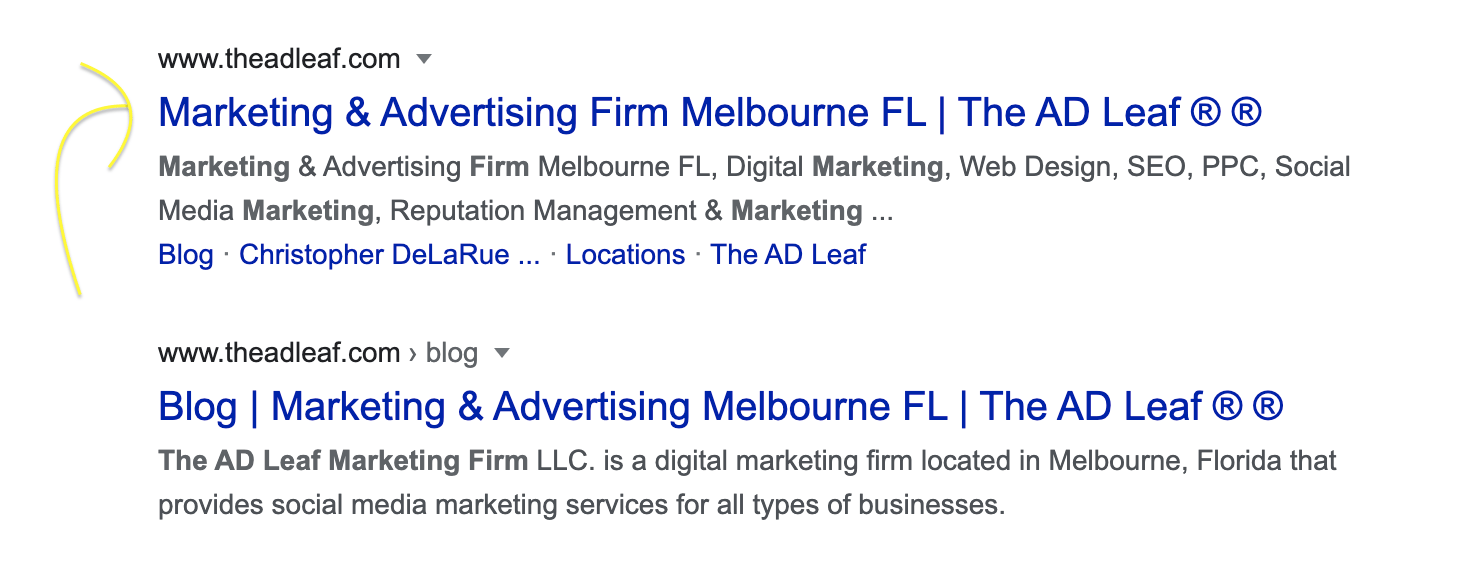
This is the main thing that appears in a Google search. The headline or main text you see before reading the description. This should be optimized to catch the attention of a quick browser. 

the-ad-leaf-google-marketing

  • Meta Description

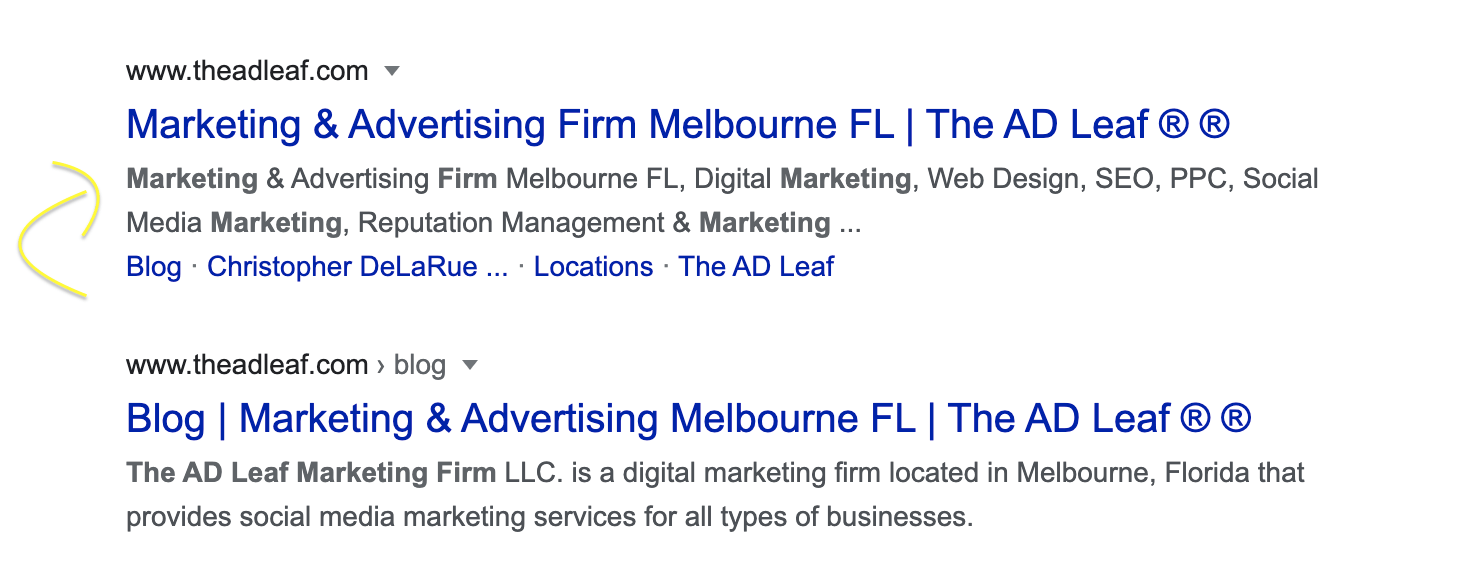
This is the quick snippet below your title tag. This should be optimized to fit your target keywords as well as support the users’ readability when they’re browsing search results. 

the-ad-leaf-google-marketing

  • Keywords

Speaking of keywords! Keywords are individual words or phrases that someone might search in order to find your product or service. Your title tags, meta descriptions, and website content should be optimized to support your focus keywords. It’s important to put yourself in the shoes of your customer and imagine what they would be searching for and not what you would search for. You’re knee-deep in your industry so the terms of verbiage you would use to discover your own company might be lost on the typical user. 

  • Domain Authority

This refers to how a whole domain (like www.theadleaf.com) will rank on search engine results. It’s typically calculated by a combination of things like link metrics, root domains, number of other links, and other things on a 100-point scale. This measurement is used internally by Google to see how your website compares to others in regards to your keywords. 


Commonly Used Social Media Terms

  • Engagement Rate

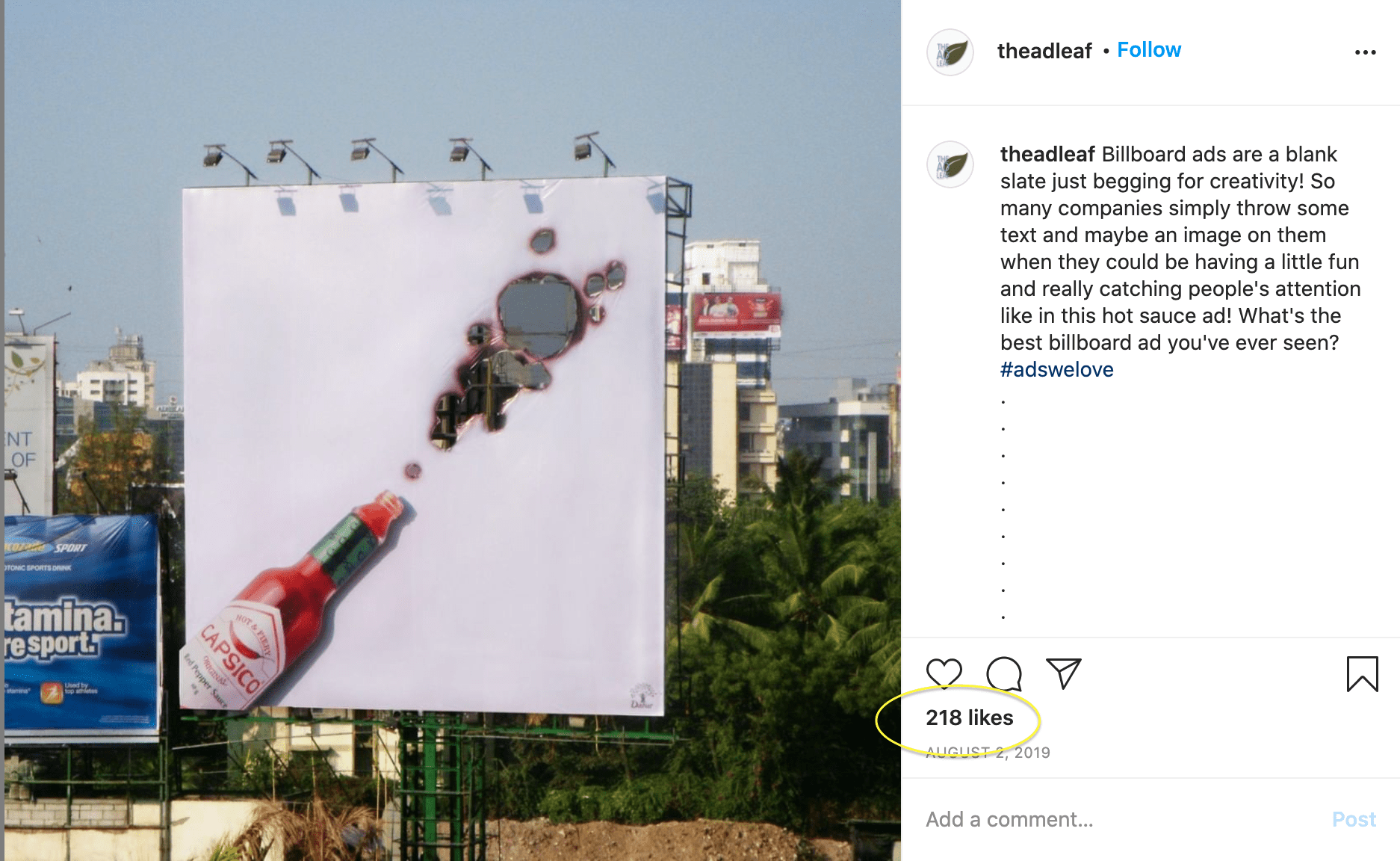
This is the rate at which your followers share, like, or comment on your content. This is a great way to determine whether or not your content resonates with your follower base. A quick way to calculate this is to take the average number of engagements you’ve received on a singular piece of content (like a post) and divide it by the number of followers you have. 

let's-talk-marketing-billboard-hot-sauce

  • Pixel

If you’re running Facebook Ads and have a large ad budget, this is necessary to build strong audiences. A Facebook Pixel is a tracking code added to your website that tracks and monitors the users that visit your website as a result of Facebook. You can use the data from this Pixel to build Lookalike Audiences and build Remarketing/Retargeting campaigns. 

  • A/B Split Testing

Another fun one for when you decide to start running paid advertising on social media! A/B Split Testing is the practice of taking two different types of ads that have one variation between them. For example, you may create Ad A with a caption, graphic, and budget. To successfully conduct an A/B Split Test, Ad B should vary one of those items. If you’re stuck between two different graphics/images, run Ad A with Graphic 1 and run Ad B with Graphic 2. This will allow you to test the variables against each other and see which one was more successful. 

  • Boosted Post

You’ve probably heard this term before if you’d ever taken a peek at Ads Center on Facebook. This function allows you to “sponsor” a top-performing post and get it in front of more users. This is done primarily to grow your audience and increase your engagement. It will show it to more of your current follower base and may be shown to users who don’t follow you. Boosting posts is very different from running high-level ads as the targeting options are very limited and the capability to be creative is limited. 

  • Evergreen Content

This type of content is crucial to your organic social media campaigns. Today, most social media algorithms are based on activity and not based on chronological posts. You’ve probably noticed that if you like a post about a movie theater or a pair of sneakers, all of a sudden your whole timeline is filled with other local movie theaters or other sneaker brands. This means that content that’s posted can essentially “live forever” on social media. It’s important that you incorporate content into your campaigns that are applicable to your target audience whenever they see it, any day, any time, any season. This type of content is “evergreen” because it’s always green and is applicable year-round. 


Commonly Used Email Marketing Terms

  • Hard Bounce

This is what happens when an email campaign is returned from an email address you sent it to because the email address is either incorrect or no longer active. This does count against your domain’s quality score if you have too many hard bounces. 

  • Soft Bounce

This is slightly different than a hard bounce. This is what happens when an email campaign is returned from an email address due to a technical error like the recipient’s email inbox is full or their server was down and unable to receive emails for a period of time. This doesn’t count against your domain’s quality score because these are unable to be controlled. 

  • CTRs

This stands for Click Through Rate. This is the number of people who click on a link, button, or icon in your email campaign and end up on your desired landing page. An easy way to calculate your CTR is to take the number of users generated from your email campaign and divide it by the number of emails you sent. The final number is your CTR. Generally, you should be aiming for a CTR between 10-15% but this may vary depending on your industry. 

  • Open Rate

This is the number of recipients who open your email. It’s important to keep track of your open rate so you can determine whether or not the campaigns you’re sending are relevant to your audience. The way you calculate this is similar to your CTR. Take the number of emails opened and divide it by the total number of recipients on your email list. 

  • List Segmentation

Segmenting your list is incredibly important. This is the practice of taking similar groups of email recipients based on a variety of factors and creating a new list with just a select number of emails. You may want to create a list based on a recipient’s geographical location (like what State or Town they live in), the company/industry they work for, their age, their gender, or any other qualifying factors. This will allow you to craft campaigns that are unique to each subset of your email list. 


Don’t feel overwhelmed if you’re talking with one of our team members and you don’t understand a term we use. If you’re not sure what we’re talking about- ask! We love getting to talk through the terms we use and explain what they mean so you can fully understand the services we’re providing for you. We want you to feel comfortable knowing exactly what we’re doing for you! If you’re ready to get your marketing campaign started, give us a call at 321-255-0900 or email us at info@theadleaf.com and we’d be thrilled to take you on the journey with us! 

the-rise-of-tiktok-and-its-marketing-prowess

The Rise of TikTok and its Marketing Prowess

Over the past two decades, social media’s rise has created a drastic shift in how companies market to their consumers. However, every few years, a new platform has popped up and changed the landscape regarding how digital marketers approach their advertising strategies. The latest of these platforms to have caused this change is TikTok. This short-form video platform rise is thanks in part to its unique algorithm, known as the for you page. The for you page provides its users a personalized experience, unlike any other major applications.

This has made TikTok the fastest growing social media platform of the decade, with over 700 million active monthly users across the globe, and in August 2020, it eclipsed over 100 million quarterly users in the United States, according to TikTok. Also, the majority of their userbase is under the age of 30 years old. So, this opens companies up to the younger demographics in a place that they natively frequent.

However, TikTok is still growing and has not matured like the four major platforms (Facebook, Twitter, Instagram, and LinkedIn), which means that it’s not saturated with advertisers, so it is the best time for companies to take advantage of its marketing aspect.

Developing a Strategy

The development of a TikTok strategy and its implementation can help businesses grow their consumer base in those younger demographics. However, it necessary that they present content in a way the younger demographics prefer. This is because they have learned to tune out traditional advertisements, but that is where TikTok thrives with its organic-centered content. Developing an organic strategy that highlights a company culture and the behind-the-scenes action allows the users to connect with a business at its core.

You Have the Views… Now it’s Time to Engage Your Audience
The content creation and posting portion are now up and running. However, that is only the first part of the battle of not only attracting but, more importantly, retaining the audience’s attention, which keeps them coming back to your page. This rapport-building is essential as it helps establish that ever meaningful relationship that can convert them from fans to actual customers. So, the key to this is being readily available to engage in the comments quickly and then expand your reach by interacting with your followers. This interaction shows you care about them as much as they care about your brand.

Leveraging Goodwill
Once those users have connected with your brand and like what value you are providing them, it is now time to convert them into consumers by slowly introducing your product or service into your feed.

We Have Organic Success… What’s Next?
Your business has built that organic following and has seen some conversion, but now you want to take it to the next level as you have developed an audience that you believe represents your target market. How do you scale this to that overall demographic?

Paid Advertisements
TikTok ads are still relatively new compared to their main competitors, which means less competition and more chances to get your content to that audience you have developed via your organic outreach. So now this pivots some of your attention to that development of your paid strategy that will focus on selling your product or service but remember that you still must interact organically with your primary consumer base. This necessary organic interaction exists because if you stop doing it, they will feel ignored and potentially start engaging in a harmful way with your page, which could turn others away.

How do I Achieve This?
This is a lot of information and ideas on building a winning strategy on the newest social media darling. However, you feel overwhelmed and do not feel like you have the time or knowledge to achieve your growth goals without guidance from the marketing world?

TikTok Strategy
Well, this is where we can help here at The AD Leaf Marketing Firm LLC., as we have begun the process of developing a strategy that will put you at the forefront of the TikTok platform and its business users. We know that knowledge is most of the battle that causes people to take on a new platform. So that is why we are willing and able to provide you the guidance needed for you and your team to execute a unique strategy that takes your TikTok strategy to the next level?

CONTACT US
So, looking to get started on becoming that next company that has a big break on TikTok? Well, then give us a call here at The AD Leaf Marketing Firm LLC. at 321-255-0900 and schedule a free consultation with our marketing team and let us and our social media specialists get you where you want to be!

using-social-media-stories-to-your-business-advantage

Using Social Media Stories to Your Business’ Advantage

Even if they are only on your page for 24 hours, using social media stories to your business’ advantage can be very useful. If you are looking for a way to incorporate Instagram Stories and Twitter Fleets into your marketing, contact our experts at The AD Leaf ® Marketing Firm LLC. today! 

  • Around half of Instagram’s total base uses the Stories feature.
  • Keeping on top of trends and new features is appealing to new customers.
  • You can track how engaging your followers find your content. 

In November, Twitter launched its new feature called Fleets. Following in a similar vein to Instagram’s Stories feature, users are able to share short-form content for a limited amount of time. You can customize this content with text, GIFs, or even links that will take whoever clicks on it to a web page. 

Not only that, but Stories is not the only interesting tool that Instagram has to offer. They also recently launched Reels in August, which are fifteen-second videos that are featured on a special part of the Instagram app. Since these are separated from the general post and Stories feeds, you are able to reach people that may not follow you yet. 

If you and your business have a social media presence, you can utilize these features to drive up business. If you are unsure of where to start, let the social media experts at The AD Leaf ® Marketing Firm LLC. guide you towards a strategy that works for you.

Give Your Customers an Inside Look into Your Business

Customers are always looking for the human aspect of small businesses like yours. That is why it is a great idea to pull back your curtains sometimes to show the daily operations of you or your employees. Using Fleets and Stories are a great way to do this. As they are only on your page for twenty-four hours, you do not have to worry about bothering your social feeds with individual posts about your company. 

Offer Exclusive Discounts and Offers

As a business owner, you understand that urgency is one of the best feelings you can instill in a customer. You want to convince your audience that they should not miss a sale or opportunity as much as possible. By posting these offers on a platform that erases posts after twenty-four hours, this sense of urgency is effectively conveyed.

Interact with Your Customers

One of the major differences between Instagram Stories and Twitter Fleets is the fact that Stories is more user-friendly. This is because the platform offers “stickers” that allow your audience to vote in polls or ask questions. An idea that you can do with these stickers is to ask your customers to vote for their favorite product or service they’ve invested in this year. Although this is a feature currently not available in Fleets, chances are that something similar will be available in the near future. Using social media stories to your business’ advantage is also a great way to interact with your customers.

Customize Your Social Media Strategy Today

If you are interested in learning more about how Stories and Fleets can be used to market your business, contact The AD Leaf ® Marketing Firm LLC. today! We can work with you side-by-side to determine the best course of action for your social media strategy. To schedule a free consultation, call us today at 321-255-0900.

Advertising To Your Audience on Facebook

Social media is the most relevant advertising channel for Generation Z, Gen X, and millennials. These younger audiences are open, responsive, and primed to receive advertising messages as they browse their feed. If you want to target this younger demographic, paid social media advertising will help.
 
Social media is the most effective channel to inspire potential buyers to purchase from brands. Especially if you’re ready to invest in video ads. Marketers disclosed that they are increasing their digital video budgets by 25% year-over-year since video is widely preferred by consumers. Depending on your budget, you can get super specific with ad targeting to reach qualified customers and patients.
 
The problem with a lot of typical advertising that isn’t on social media is that they have no specific audience to target to and initial campaigns waste a good chunk of money fishing in an empty pond. While eventually, a target audience may be organically discovered this way, it’s highly unlikely that it will happen overnight.
 
With social media, you’re not necessarily fishing in an empty pond. It’s more like your fishing in a pond with a massive amount of very small fish that will very quickly turn into full-grown fish that you will eventually find yourself reeling in. With over 2.7 billion monthly active users as of the second quarter of 2020, Facebook is the biggest social network worldwide.
 
Instead of marketing to the masses and getting nowhere, your audience is already on social media and primed to buy. Strategic social media advertisements pop up in front of people at the right time, educating them about your product or service and motivating them to make a purchasing decision.
 
Social media has changed how advertisers find their true target audience. With specific ways to target demographics, location and even a potential consumer’s interests, targeting your audience is now common knowledge when it comes to digital marketing on social networks.
 
The largest demographic on Facebook is men ages 18-34, making up 35% of active users. Simple things like targeting a specific gender can change your ad campaign completely. Additionally, when setting up a new campaign almost all social media advertising platforms will ask you for an objective; be it video views, website clicks, post engagements or sales. Once this has been defined, the platform will use previous user behaviour data to put your ads in front of the people that are most likely to perform your desired action.
 
Many businesses end up boosting posts on Facebook as prompted by the platform. Boosting is an easy and cost effective way to get more exposure of a post and can be very successful for competitions, photos, blog posts and other posts that are not sales orientated.
 
However, when boosting, note that you are only able to use basic targeting functionalities and Facebook will target users more likely to engage (likes, comments, shares) rather than link clicks by default. Therefore, if you are running a campaign that’s designed to generate conversions, consider exploring the Facebook ads manager platform instead.
 
With social media advertising, there is less intent, you are simply targeting someone because they meet the profile of your target audience, they may have no interest in actually using your services or buying your product. The exception to this is when you use the Facebook pixel as when retargeting previous visitors of your website, you can assume higher intent.
 
The effectiveness of a social media platform will depend largely on your target audience, product or service and budget. However, Facebook could be considered to have the most advanced advertising features of all social media platforms and also has the largest user base. A person’s social media account tells you a lot about them, and social media advertising platforms allow you to utilize this data to put your ads in front of the right people. The more interested in a topic a person is, the more likely to click an ad with that interest in mind.

Digital Vs Traditional Marketing: Who Will Win?

Digital Media: 

Since the rise of social media in the early 2000s, marketers, and companies saw a new avenue to market their products and services to a much larger audience. An audience much larger and easier to reach than traditional marketing channels. Social media gave marketers a fabulous way to measure the success of paid media campaigns: analytics. Analytics has given marketers a unique tool to see tangible evidence that their efforts are having an impact.

According to the 2019 Social Media Marketing Industry Report. Marketers have identified two key benefits to social media over the last 5 years. 

86%  of marketers found their social media efforts have generated far more visibility

78% of marketers found their social media efforts have led to more traffic to their brand’s social media.

Digital marketing has been on the rise as technology becomes more apparent in our daily lives. Digital marketing will only become the dominant form of marketing in the years to come as technology advances. As it is only 24% of Gen-Z watches cable tv and Millennials only 41%. 

Gen – Z is becoming known as the “cord-nevers” since they are the first generation to grow up in a purely digital age. They don’t watch cable because they grave content and are more likely to grave videos over other forms of content. Which puts traditional media outlets in a precarious position. 

Traditional media:

While traditional marketing is still effective (for now) it is however nothing new. We have seen it in one form or another whether it’s from a tv commercial, print material in big box stores, a billboard while driving, or a magazine in the doctor’s office when our cell service won’t connect. 

All though traditional media has evolved over the last 20 years the fundamental aspects remain the same and it still remains limited in the digital age and with an evolving consumer base. Some forms of traditional marketing will outperform others, radio segments and podcast advertisements will outlive tv commercials as more people move to podcasts to get updates on current events in the world instead of the mainstream media. As it is, over 63 million Americans listen to podcasts each week. This presented a greater opportunity for podcast advertising. Currently, Podcasts are projected to generate 1 billion in revenue by 2021; according to the Internet Advertising Bureau (IAB). 

Who Will Win?

Both traditional marketing and digital marketing use the 4 P’s of marketing: Product, Price, Promotion, Place. 

Traditional media uses this as an integral part of creating a sales funnel and planning marketing campaigns. While traditional media can do well with price, product, and place it lacks in the fourth P: promotion. It’s too easy to ignore it and it doesn’t connect with people, it’s just there. Digital marketing, on the other hand, is very different and it uses the 4 P’s of the marketing mix effectively and in a unique way and at most times better than traditional marketing. 

The drawbacks of traditional marketing are that it does not reach about 50% of its audience, it’s more costly, you can’t measure your ROI, and can’t measure consumer feedback. As it is more marketing across all industries are shifting their efforts online, most consumers now do their product research online before making a purchase.

No matter what industry your business is in you will need to establish a digital presence and actively work to build your digital marketing strategy. We have already seen big box stores such as Sports Authority, Toys R Us, and Sears file for bankruptcy because they could not understand the importance of Digital Vs Traditional Marketing.

Social Media in Business: The Search Beyond Leads

In the marketing industry, one of the most common concerns with business owners is leads. They want to ensure, matter of factly, that hiring an agency or firm to manage their social media content will result in viable leads. 

Will consistently posting content on social media platforms result in leads? Likely, yes. However, this is not fully the point of upkeeping social media platforms, and it may take time for this result to occur. Your social media is almost entirely about creating awareness and trust with your audience. Consider applying these topics to your current perspective on the purpose of social media:

  • Brand Awareness

One of the most paramount aspects of why your company should have social media is brand discovery. 60% of Instagram users say that they’ve discovered new products while using the platform. If a potential customer doesn’t know of your company’s existence, they’ll never become a customer. Being discovered on social media means that you are now on their radar. 

An example of this would be a user scrolling through hashtags and stumbling on your plumbing company. Currently, they don’t need any plumbing services, so they may not follow or message your company, but now, they have seen it. Next time they have a plumbing problem, they may think back to that time they found your social account and search for your company again, potentially leading to a phone call or website click to inquire about your services.

  • Make Your Company Relatable

Human beings are constantly seeking connection. When people see your company standing for something, sharing something, they start to form trust. This may happen consciously or unconsciously. 90% of people use social media to communicate directly with brands. This is largely due to this humanization of your company through these platforms. Many people are uncomfortable with calling a company and speaking to a stranger, so social media becomes that missing link between human connection and gaining information about a product or service. 

Sharing photos of your product or service in action on an authentic level is something your potential customers typically would not get elsewhere. Seeing your staff and company culture forms the start of a basic human connection with your company. Testimonials from other people immediately increase that level of trust as well, which is something often found on your social media. Now, people know a real, living human being has interacted with your product, and that has more meaning than the number of followers or likes on your page. 

  • Growth

74% of consumers use social media to make a buying decision. One of the best ways to create actual, tangible numbers that you can notably say is making a difference for your company is advertising on social media. Advertisements are highly targeted, meaning that the algorithm on the social network is showing your product or service to a very specific group of people that are likely to be interested in it. However, showing this advertisement to a user isn’t usually enough. Depending on the price of your product, most people prefer to do research on the company before spending a large sum of money. Here’s where your social media page comes back into the narrative. 

A common type of advertisement is a traffic ad, meaning that once an interested user clicks on your ad, they’ll be redirected to your website. Your website should have a lot of information on your product, who you are, your mission, etc. If they like what they see, they’ll continue their research. This will lead them down the road of searching for reviews and real photos of your product and service at work. They’ll search to see if they feel that they can trust you and will generally make this decision based on your social media, if that is where they first found you. 

This is one of the reasons that your social media is essential. It cannot be simply regurgitating photos from your website. You need to be distinguished as a thought leader, as empathetic, as an expert. This is portrayed over a period of time, and will be seen in a matter of minutes as a user scrolls through the past several months or years of your company’s social media.

  • Top of Mind Awareness

We’ve talked about brand awareness, but now we should consider a subsection of this, top of mind awareness or TOMA. TOMA brings all of these points together. If you’re the plumber that was discovered by a social media user, you want to be the absolute number one plumbing service that comes to their mind when they need these services. For example, if you get injured, you may say you need a Band-Aid. This is a brand that holds the spot in the top of your mind for the bandage industry.

Once your brand has been discovered by a social media user, this is where the process starts. Slowly, they’ll begin to recognize your brand and gain the trust that we’ve talked about before. Company growth is a large step on the path to top of mind awareness as well. The more your brand becomes recognized and tested by potential customers, the more they will consider you a leader in your industry, and this is where you will procure viable leads and successful sales.

The Ad Leaf Marketing Firm LLC has been in the industry for almost a decade and kept up with every trend on Social Media in Business with careful detail. We would love to have you as a client and start taking your brand’s presence on social media to the next level.


The History of Social Media

3 Things You Probably Didn’t Know About the History of Social Media

People seem to have a love/hate relationship with social media. On the one hand, humans are social beings. We crave interactions with others, and relationships play big roles in our everyday lives. Social media allows us to easily connect with friends, family, acquaintances, and even strangers. This can be construed in a positive or negative light depending on who you ask and when you ask them. Whatever your thoughts on social media are, it’s pretty clear it’s here to stay in one form or another. So, how did social media even start? Was it when the first cave painting emerged? When the first telegraph was sent? Did it start with the invention of the internet? The answer to this question isn’t clear cut, but there are plenty of interesting facts about the evolution of social media along the way! Here are 5 things you probably didn’t know about the history of social media on the internet.


1. CompuServe was an early online service provider that used a method similar to time-sharing.

CompuServe Information Service, a.k.a. CIS, was founded in Columbus, Ohio in 1969 as a subsidiary of Golden United Life Insurance. Initially, CompuServe had two objectives. The first was to provide computer processing support to the company, and the second was to sell excess computer capacity to other corporations through a kind of time-share system. In 1979, it began providing dial-up online information services to the owners of personal computers. CompuServe is known as the original online portal, offering message forums, online chat services, software libraries, and even online games! It grew in popularity in the 80s and 90s and was sold to AOL in 1997 with WorldCom acting as a broker for $1.2 billion in stock.


2. One of the first social media services was SixDegrees.com.

This social network site was named after the six degrees of separation concept, which is the idea that people have an average of six degrees of separation from each other. SixDegrees was founded in 1996 by Andrew Weinreich, and the website launched in 1997, making it one of the earliest social media sites on the internet. SixDegrees allowed users to create profiles, list their friends and acquaintances, and interact with other users. At its peak, SixDegrees had about 3.5 million registered users. Just two years after its launch, it was sold to YouthStream Media Networks for $125 million. SixDegrees was short-lived, though, in part because of the limitations of internet connectivity in the late 90s and early 2000s. It shut down in 2001. 


3. Users could rate the attractiveness of strangers on AmIHotOrNot.com.

James Hong and Jim Young, both engineers based in Silicon Valley, disagreed one day over whether or not a woman they passed on the street was attractive. Their solution? To create a website, of course! In October 2000, the two friends launched AmIHotOrNot.com. The site allowed users to voluntarily submit photos of themselves to be rated on a scale of 1 to 10 by others based on their attractiveness. It went viral. Within one week of launching, the site had reached nearly 2 million daily page views. The site incorporated dating and matchmaking elements.

Aspects of Hot Or Not impacted later dating apps like Tinder and OkCupid. The site was even said to have influenced Mark Zuckerburg to create FaceMash.com, where Harvard students could rate the looks of fellow students based on their student ID photos. Unlike Hot Or Not, FaceMash did not allow users to submit photos voluntarily. FaceMash received major backlash, both because students felt it violated their privacy and because it was seen as a copycat of Hot Or Not. After being called before the school’s administrative board, Zuckerburg took the site down. Hot Or Not was sold for a rumored $20 million to Avid Life Media in 2008. 


There are plenty of interesting stories when it comes to the history of social media. From computer time-sharing processes to rating the looks of strangers, there is a lot to learn about how social media has evolved. If you own a business, you probably know how important it is to be able to connect with your customers, whether it’s through an interactive website or your social media channels. If you’re looking for a marketing company with a stellar reputation to assist with any aspect of your digital marketing, look no further than The AD Leaf. We offer web design, search engine optimization, email marketing, social media management, digital advertising, and more! Give us a call today at (321) 255-0900 to learn how we could help you grow your business.

Be Concise! Less Is More With Email

Email: The Foundational Tool

In the world of marketing, email is one of the most fundamental tools at our disposal. It maintains its mainstream appeal through its accessibility to clients and consumers alike in communicating time-sensitive information. As foundational as email marketing is to the practice, new trends are still emerging that maintain its modernity.

One emerging cultural trend that has been incorporated into the way we use email in marketing is minimalism. Minimalism has impacted email marketing by transforming emails from long-winded chunky blocks of text to concise straight-to-the-point communications that are easily digestible for consumers. 

Why Less Really Is More

  • Ease of Consumption

Skimming has taken over the way we digest media. Our eyes pick up on keywords and bolded text to access the importance of information and let our minds fill in the blanks. With such an excess of media to consume, our time to absorb it all has remained the same. To account for the discrepancy, we’re largely left with one of two options: skim the content or condense the material itself so that it’s less to read. As a marketing professional, making the material easier to interact with is where we step in.

  • Consideration for the Reader’s Time

Clients and customers are on a time budget. Their email accounts are bombarded with numerous emails not unlike your own. Being courteous and condensing your content and information into concise language delivers your goals without sacrificing the time of your clients and customers which they will be appreciative of in the long run. Requiring less reading time from your customers and clients inevitably allows them more time to follow through with the action your email is asking of them.

  • Earn the Favor of Your Audience

Recipients on your email list will value your content more if you show respect for their time and energy. Being concise and writing clearly consistently builds a reputation for the communications you disseminate to your audience. They’ll know what they’re getting every time they open one of your business’ emails and know that it’s going to be easy on the eyes and easily digestible. This will improve your open rate and translate into more conversions for your goods or services and better business for all parties involved.

  • Condensed Writing Encourages Clearer, More Engaging Content

Whittling down the length of your email content forces you to weed out unnecessary information. It forces the writer to think carefully and consider the necessity of each word and sentence. Editing your email content in this way inspires creativity in the way each piece of information gets delivered. Editing out extra sentences and words encourages clearer thinking on the part of the writer and the intended audience as well. The result is writing that gets straight to the point and tells the recipient what they need to know without requiring a substantial time investment.

  • Images and Bulleted Lists Are More Substantial

Substituting lengthy blocks of text with pictures and bulleted lists break up monotonous reading. They capture interest, convey meaning without requiring as much reading, and make for a more aesthetically pleasing design. The old adage, “a picture is worth a thousand words” exhibits the staying power of this email marketing trend of conciseness.

Bulleted lists benefit this strategy as well by grabbing the attention of the reader and directing them to smaller blocks of important text. This gives you as the writer the opportunity to position some of the most valuable pieces of information to a spot you know the reader will see them.

  • Know Your Audience

Of course, different emails and different email recipients require a different depth of information so it’s important to consider your target audience and who it is that will eventually be opening your marketing emails. A technical client will likely require more in-depth dialogue in their marketing emails based on their industry than regular clients will. If the situation calls for more writing follow your gut and do what you think is best given the situation.

Transform the Way You Reach Your Customers

Looking to increase the open rates or improve conversions of your email campaigns? The AD Leaf ® Marketing Firm, LLC is specially fitted to transform the way you reach your customers and clients. Our team of marketing experts has the experience and knowledge to take your future email campaigns to the next level. Contact us today for more information about how we can help!

How Your Brand Can Capitalize On TikTok’s Popularity While Saving Costs and Ensuring Stability

The social media scene had remained relatively the same for the past several years. One of the only significant interruptions since the rise of Facebook, Twitter, YouTube, and Instagram is the quick and overwhelming popularity of the app TikTok. TikTok has a unique algorithm that allows creators to rise to popularity at more rapid rates than ever before! Since the app’s creation in 2016, it has gained over 800 million users worldwide. If your brand does not participate on TikTok, don’t worry. The app can still be used to promote your brand without even having an account.


TikTok’s algorithm allows users to see the posts of creators, even when the users do not follow them. This stands true to other apps, but for TikTok, it happens at an unprecedented level. Most users mainly view content made by creators they don’t follow. This is due to the “for you page” which is the most commonly used feature of the app. It shows content to the user that the algorithm predicts they will be interested in based on their previous interactions. This is a huge win for brand promotion! For example, if you pay a creator to promote your product, more people than just their followers will see it. However, it can be expensive.


For creators with large followings, a good portion of these followers will also follow them on other apps such as Instagram and Twitter. 


Why is this important for your brand?


  • If someone takes the time to follow a TikToker on another social app, they are a more dedicated fan who wants to keep up with the influencer.
  • They often purchase the merchandise of these influencers and are more likely to trust their opinion.
  • Since only a portion of their fans will follow the influencer on these other social media platforms, their follower count is typically lower.
  • Due to a lower amount of followers, securing a brand deal on their Instagram account will be less costly.


One example of this is the TikTok creator @nmillz1. He has amassed more than 2.2 million followers on TikTok in a short amount of time, but currently has only 270 thousand Instagram followers. Charli Damelio is arguably the most well-known TikTok creator securing high-profile sponsorships frequently. She has 90 million followers on the app, while having 30 million followers on Instagram, or one-third of her TikTok fan base. This case is interesting because many people who do not even have TikTok know of Charli, and she is considered to be one of the only creators from the app to rise to actual celebrity status. Her case especially identifies that people who follow a creator on TikTok often do not hold enough interest in them to follow their other social media accounts like Facebook, Instagram, Twitter, and YouTube. 


This gap allows you to capitalize on TikTok’s extreme popularity in a less costly way to a TikToker’s most dedicated fans. You can do this by proposing a brand sponsorship through Instagram. A brand sponsorship is much more costly than just posting an advertisement for your product, but seeing the brand talked about by someone the fans look up to will likely result in more sales and engagement for your brand.


What Does It Typically Cost to Hire an Instagram Influencer?


  • 2,000 to 10,000 followers – $75 to $250
  • 10,000 to 50,000 followers – $250 to $500
  • 100,000 to 500,000 followers – $1000 to $3000
  • Over 500,000 – $3000 +


Large TikTok influencers will either charge a high flat fee, or they will charge per view to promote your brand. According to TalentX Entertainment, a management company for 32 influencers, they charge $0.01 to $0.02 per view on TikTok. The problem lies within the fact that as a brand, you can not control how many views a TikTok post will get. Someone with only 10 followers can post an extremely viral video and get millions of views, while someone with 100,000 followers may only get a few thousand views. The algorithm is very unpredictable and is not publicly released, resulting in a risky investment for marketing. Instagram, on the contrary, is very predictable. An influencer will maintain roughly the same amount of engagement on their account, so you know what you are investing in.  


Going back to the TikTok creator @nmillz1, his TikTok videos frequently receive several hundred thousand views, which would result in costs roughly at $5,000 to $10,000 or more, while a sponsored Instagram post would be less than $3,000 and seen by more dedicated fans who trust the influencer. 


In summary, your brand can capitalize on TikTok’s rise to the top without even interacting with the app. If you are considering a brand promotion with an influencer, a TikTok creator’s Instagram page can be a great resource for you.


Sources:

https://www.digitalmarketing.org/blog/how-much-does-influencer-marketing-cost

https://www.searchenginejournal.com/heres-how-much-brands-are-paying-for-sponsored-content-on-tiktok-youtube/346290/#close


Social Media Trends For 2020

Staying Current: Six New Social Media Trends of 2020

Social media is all about living in the moment. What might have worked a few years ago or even months ago, may not work today. Your customers will notice your efforts to stay relevant and appreciate that. And that will reflect in your brand image and customer loyalty.  Let’s review some social media trends, new tactics, and content ideas for 2020 to try and implement to ensure you finish off Q4 strong:

1.Ephemeral Posts: Nothing Gold Can Stay. 

The first trend is the growing popularity of “ephemeral” posts or temporary posts. Many social avenues have rolled out content features designed to be appreciated for a small amount of time before they disappear forever. Examples of this include Facebook and Instagram’s story features, as well as reels and TikTok. Although reels and TikToks may have a more lasting nature, they are meant to be more “disposable” than permanent and higher-quality feed content. One way to add to the story features without creating new content is to simply repost older posts onto the story. When you do create new stories, you can extend their lifetime by adding them to a highlight at the top of your Instagram. 

2. E-shops: The Convenience Customers Expect

The second trend is the implementation of social commerce. Many social media platforms are integrating online stores as another feature of a profile. Facebook rolled out its “shops” feature and Instagram allows you to buy right off a post. Pinterest has shoppable pins where purchases can be made right on their site or linked to an external site. Note that this will only be useful for brands that offer physical items as digital downloads are not yet available for sale on these services. Brands with established Shopify’s can more easily transfer their products to these social commerce features. 

3. Video Content: Now Playing

The third trend is the rise of video content. Multiple studies including one by the Cisco report that over 80% of all online content will be video by 2022. Now is the time to feature videos on social media. Integrating video within content that was typically only text in the past is a great way to stay relevant and impress your audience. 

4. Legal Media Ownership: The Ghosts of Limewire’s Past

The fourth trend is more legal and regulatory monitoring. When posting to social media it is crucial that the agency who creates your content is using legal sources and avenues for media. Using an image or song that belongs to someone else without permissions or is copyrighted can land you in court paying hefty fines for a simple mistake. Of course, the best option is using your own photos but this doesn’t work for all business models or clients. Most important is having an agency with access to copyright-free images. Don’t let your company sign with a low-tier agency that doesn’t understand this and makes a rookie mistake that sinks profits. 

5. Local Geotagging: Coming To A Small Business Near You

The fifth trend is the rise of location-based targeting for local brands. Of course, if your company is e-commerce or is looking to reach a demographic of people across multiple states/countries, this won’t apply to you. But if you have a local business particularly in-person service (i.e. vehicle rental, house cleaning, lawn service) this aspect of audience targeting is crucial. Your agency and coordinator must understand that reaching a person 3 states over doesn’t make any sense and is a waste of time and space on captions/hashtags. Hashtags should be like #losangeles rather than #lawnservice for example. The targeting goals for companies that fit into this category should be quite regional and should know the mile-range of their farthest customer to make sure they aren’t missing an opportunity for a sale. 

6. Public Insights: Social Media As A Focus Group

The sixth trend is using insights from social media to shape business strategy and models. If you think about social media as a one-way street, you’ve got in all wrong. You can benefit from the interactions on social media just as much as your audience. Have you ever wondered what your customers really think about your business? By searching publically available search terms and keywords, you have the ability to be a fly on the wall. This strategy also works for general industry terms and adjacent/parallel industries. If you provide an organic peanut butter product, maybe you’re wondering what customer’s jelly habits are as it relates to peanut butter. By simply searching those words, you get to see what people are saying. This tool is incredibly valuable as you are getting a ton of primary research data for FREE. Primary customer interviews and focus groups traditionally cost thousands of dollars, so take advantage of this secret tool. 

By riding the waves of these new social media trends you can achieve everlasting cultural relevancy and clout within your target groups. More important than the actual execution of these trends, is showing your customers that you’re aware of them and are trying to participate. This gains trust and respect, especially with younger and savvier audiences who expect brands to be on top of this. We are a digital marketing agency that understands these 6 social media trends and their importance in 2020 and beyond.  Call us or fill out a contact form today to set your business up for success Q4 to end this year strong in sales.