Content Marketing

Making Creative Content with Results

Content marketing is a tried and true method of grabbing your audience’s attention. However, this has its downfalls because you have to compete against your peers. You want your content and blogging to stand out. This is why giving your content a creative spin is so important. There are a number of ways you can help your content give an extra twist.

Decide What You Want To Market

Before you get into the nitty-gritty of making your content, you first need to decide what exactly you want to market. Perhaps you have a new service you want to announce to your customers, or maybe you just want to amplify a service most of your customers did not know you offered. Whatever it is that you want to market, make sure that your marketing focuses on this product or service. You want to make sure that its usefulness and benefits are still the main focus.

Define Your Audience

You want to make sure that both the concept you are marketing and the marketing you plan to execute revolves around your target audience. Who do you believe will benefit the most from this product or service? 

For example, if you are a roofing company that wants to market your shingle repair services, you want to market yourself towards homeowners. If you want to go further, you may want to research online search trends to see further demographics who might be interested in your services, such as gender and age.

Types of Creative Content

Now that you have decided what to market and who to market to, here is the fun part: deciding how to creatively market your product or service. There are some different methods and mediums you and your business can utilize. Here are just a few:

We will be walking through the benefits of using these types of creative content for your marketing, as well as why you should choose The AD Leaf ® for whatever creative content production you decide upon. 

Videos For Content Marketing

Videos are great for easygoing and quick bites of information. Your customers can use these videos to gain a basic knowledge of your service or product. Furthermore, videos can be easily accessible to your consumers, as they are easy to share onto multiple platforms. The AD Leaf ® can help you create the perfect marketing videos using the best equipment and software on the market.

Blogs For Content Marketing

Blogs are perfect for customers who want a more in-depth and intimate explanation of your services and products. They are also a great way for your audience to get to know your business on a personal level through blog posts on your employees and your company’s culture. The AD Leaf ®’s team of content marketers will be able to guide you through the blog-writing process in an easy and efficient way.

Electronic Media For Content Marketing

Electronic media marketing can apply to anything from television advertisements to email marketing. This can result in new customers finding out about your services or products and older customers coming back to you for repeat results. Whatever your electronic media marketing needs are, The AD Leaf ®’s team of experts will help you decide what is the best course of action for your company.

Print Media For Content Marketing

Even in an environment populated by digital media, print media marketing is far from dead. Print advertisements are more flexible to promote, as you are able to choose where you want to publish your advertisements. The AD Leaf ® will help you determine the right course of action for your print media to make sure you are reached to as many potential customers as possible. 

Infographics For Content Marketing

For people who want the basics of your business and products, infographics are a great way to share your information. The effectiveness of infographics has been scientifically tested, with researchers at Thermopylae Sciences and Technology discovering that people “[process] images 60,000 times faster than text”. With this in mind, let The AD Leaf ® help you condense your important information into an easy-to-digest infographic with our graphic design

Social Media For Content Marketing

Finally, social media is perhaps the biggest source of creative content marketing on the market at the moment. It is so effective because you can create your own campaigns centered around your service or product while also promoting your other campaigns; for example, linking your blog post on a social media site can increase traffic towards that blog post. The AD Leaf ® can help you create the perfect social media strategy for you and your business.

Contact Us

Here at The AD Leaf ®, we are committed to providing you with the best and highest quality services possible for your business. We specialize in various different types of marketing, from video production to social media. Call us at 321-255-0900 or visit our website to schedule an appointment today.

Social Listening- Take Your Social Media to the Next Level

“The customer is always right” has been the rule of thumb for as long as businesses have existed. Return business depends on the customer feeling valued. Being valued begins with listening.  Listening to the customer means not only hearing them but understanding what they want.

This concept is put into practice by a business by listening to the customer and what they want. This practice is no different on social media when it comes to your company’s brand and what you are putting out into the world for the customer to see. A practice and example of this that I was taught early on in my career, paraphrasing, “My favorite color is blue but that doesn’t mean I can put blue everywhere and use it in every campaign. I am catering to the customer and their desire. Just because my favorite color is blue does not mean that it is everyone else’s favorite color.” 

As humans, we are visual beings when it comes to consumerism. We make a judgment based on the first thing we see. If what we are seeing is not desirable, we move onto something else that does catch our eye. Listen to your new followers and most importantly, returning customers on social media to what they want to see. They are your audience, connect with them.

By ignoring what our audience wants we are disconnected from them. When we are disconnected from our audience, we cannot service or leave an impact on them. Companies often guess at what an audience wants to see versus listening to what they want. If any of this applies to your company, make a plan of action and ask yourself questions: “Who is the audience? What do they want to see? What could be a more effective way of connecting with them? What performs the best and gets the most engagement?”

Companies monitor their social media, which is a necessary part of a social media campaign, but it is taking bits and pieces of information versus looking at the whole picture. Engaging with your customers and assuring them that their comment has been seen is great, but did you listen to that person when they made a comment? Proper social listening means looking at the industry your company belongs to as a whole versus your one small piece of it. What is working for other companies that might be more successful than yours? How could you use it as inspiration and do something similar, but more importantly, better? 

Let’s look at social listening and social monitoring from a business performance perspective. Imagine you are a business owner with more than one location. If one of your locations was performing better than another with the same location to customer ratios you would listen to the customers leaving poor reviews and initiate some type of change as a result. This change would be put into motion with an investigation as to why one store is getting better reviews than the other. For example, if a review was left saying “Business- Location A is much more attentive when I come in to shop than Business-Location B, it takes ten minutes for someone to ask if I need help at Location B and at Location A someone is ready to help me as soon as I walk through the door.” As a business owner, you want both locations to be equally successful, so you would address the customer and acknowledge their complaint. Next, you might put a standard in place to greet customers and ask if they need help when they come into the store versus waiting until they look like they might need help after a period of time. By addressing the customer, you are monitoring the issue and bringing awareness to it but taking it that one step further to make a change in your store locations you are listening.

With that example in mind, look at your social media campaign the same way. If a specific type of post is performing better than another, listen to what your audience is saying and make a change. Research other companies in your industry and see if their top-performing posts are similar or different from your top-performing posts. If they are different see how you can change a type of post that is not performing as well as you want to align closer to what your audience is responding positively to. Making a change to a low engagement post has no negative outcome. If the post responds equally or worse than the original, you can always go back to the original style of the post but if it performs better than you’ve created more brand awareness and listened to what your audience wants.

Social listening can improve the health of your brand, give an insight into what works versus what doesn’t, and analyzes the competition versus your company’s campaign. Take advantage of your social media analytics to get further insight and start listening to your audience engagement. It is important to let your audience know they are seen, but it is even more important to let your audience know they are heard. An audience member on social media who feels heard but is not an existing customer could potentially be your next biggest and most loyal customer to date.

At The AD Leaf ® we understand that not every business has the extra time to invest their full efforts into social media. We are here to listen to your needs so that your customers can feel heard on social media, contact us via our phone number, 321.255.0900, or set up a consultation at TheAdLeaf.com, or you can email us to info@theadleaf.com. We look forward to hearing from you soon!

Using Social Media To Reopen Your Business

With many social restrictions being lifted within the next month, how do you plan to reopen your business? Chances are a social media method of marketing that has come to your mind. After all, marketing is the most effective way to get a message out to the public. Whether you’re a local restaurant, a flooring center, or a specialty store you’re probably very eager to open your doors to the public and begin to operate your business again. One of the most effective ways to ensure a successful reopening is by using social media to keep in contact with your customers and keep them updated on your company.


Companies that have actively utilized social media during the stay at home order have the biggest advantage. By keeping communication clear and readily available they will be fresh in the minds of customers who are looking forward to returning to normal life and supporting businesses again. Companies that have canceled communication or haven’t used social media to engage with their customers will have a harder challenge when reopening. A startling fact is that 62% of Americans get their news updates from social media. With that being said, keeping an open line of communication with your customers has never been more important to your business. If your company is currently not using social media during this time, don’t delay any further, update your customers of what’s going on for your company, don’t disappear on your customers when they need you most! 


One of the most beneficial things your business can do on social media to announce your relaunching is by creating a Facebook ad. You can use these ads to target locations, demographics, and interests to directly target your desired audience. These ads will be able to be seen by hundreds to thousands of people per day and possibly, even more, depending on your budget and ad duration. You can also choose different campaign objectives such as brand awareness, traffic to your website, lead generation, and even a call now button to get your customers engaged and ready to do business with you. A great way to utilize these is to discuss the plans of your company when your door reopens. Are you running any specials, discounts, or events? Are you changing your companies service lines or structure? These are great things that you can promote to bring the attention back to your brand. There are also other social media ads that you can run such as Pinterest ads that also can effectively capture the attention of your target audience to bring business back to you when you need it most. Visibility and getting noticed should be one of your biggest goals for marketing at this time. Without visibility, your customers will not know if you are open or closed which can be especially damaging when your customers need you most. Many people have been quarantined for over a month and returning to normal life is one of their main priorities moving forward. Now is the time to let your customers know what’s going on and get them excited about your brand. 


Using social media to communicate with your customers as well as engage with them also shows that your brand has a personable approach. With everyone dealing with hard times, now is the best time to show the vulnerable side of your company. Use it to show empathy, and show ways that you’re helping in the community and with your customer. Show ways that you are helping your workers or keeping them safe such as social distancing and sanitary practices. Difficult times like our current situation show the true character and values of a company. Use this to your advantage to show your customers why they can trust you and should do business with you. Companies that can handle the situation well and show that they care will be able to capture the most business and trust of the customer. 


It doesn’t have to al be about business though. Social media can also be used in a lighthearted approach to keep customers engaged while also having some fun. Some great ideas would be to have customers share their experiences and photos on your company page. You can also hold contests that allow customers to engage with your account to be entered into a drawing or raffle for free prizes and services. Many social media users have been bombarded with news updates about the coronavirus and seeing a post unrelated to the virus that allows them to have a little fun can be very appealing to the customer. Change up your social media posting strategy to give your customers an escape from reality while keeping them engaged with your company. 


By following these social media techniques along with an effective reopening strategy you will be able to open your business back up successfully and resume business with your customers and hopefully gain some new ones in the process. Now is not the time to retreat from social media and your customer, now is the time to re-evaluate your strategy and reconnect with your customers. Are you interested in reopening your business with the help of social media? We can help you! Contact us by phone at (321)-255-0900 or by email at info@theadleaf.com

Your Brand and Pinterest

For many years, companies have shied away from utilizing the incredibly visual platform, Pinterest. We believe this is because from early on, Pinterest began to brand themselves to speak specifically to and address the needs of a younger female demographic.

But the tides are changing.

Now, more than ever, 40% of new sign-ups are actually men, says Pinterest. Pinterest is a massive platform, though not as large as say Instagram or Facebook. But it’s growing. Pinterest has 322 million global active users, which has 200 billion pins saved.

Pinterest, according to some of these analytics, means that this platform is nothing to shy away from when it comes to your brand. 

You see, Pinterest is unique in that it’s  a place where users go to do primarily two things:

  1. They are going to make a purchase, and Pinterest helps users discover this.
  2. Pinterest users may be trying to decide what they want, and go to Pinterest to discover what that actually is.

Pinterest has a whopping 83% of its weekly Pinners actually made purchases based on the content they saw while scrolling! Seventy-seven percent of weekly Pinners discovered a new brand. The bottom line here to note is that Pinterest is a place all about the user, and a place to create something for themselves.

However…

With all of these incredible metrics, did you know that an alarming 97% of the top pins are actually unbranded? When we talk about a brand, what we are meaning is a company identity as seen through their content. Almost all of the top-pins have no identity if you will. Do you know what this means? It means there is a massive void, and dare we say opportunity, for your brand to stand out in this vast space? We believe so. This factor, along with a few other points we will mention here in a minute, show us that Pinterest may just be the secret weapon your brand needs.

So here are some helpful tips on branding from Pinterest themselves

  1. Brand Your Pins: As we stated earlier, 97% of top-searched pins are actually identity-less. They have no brand. This means that when you see a pin that may be performing well but may not be converting as well as it could because it’s not branded. According to Pinterest, when companies branded their pins and ensured there was a cross-platform brand continuity, they saw a 13% conversion rate increase! So before you go to post that pin, ask yourself if your image has a logo? What about the image itself; is it visually striking and clear? Is it vertically oriented? What about the text? Do you have a text overlay that is clear and to the point, along with clear titles, captions, and hashtags? These are just a few quick questions to ask yourself to help take your brand to the next level!
  2. Think “mobile”: What we mean by this one, and we thought it was a brilliant point, is to design for the user’s cellphone, not necessarily a desktop. According to Pinterest, 85% of their users are accessing their platform through their phones. It’s important to use your content and the pages you are sending people to are mobile-friendly. This means ensuring the font is screen readable and content is optimized for a cellphone.
  3. Brand Continuity: We touched on this a moment ago, but ensure that not only your pins but also the pages you are linking your pins to all have the same branding will help your users not feel as disjointed and create a more pleasant user experience. A simple audit of your accounts can help alleviate this with the same logos, banners, and color schemes being implemented. 
  4. Set-Up Shop: You can also create an online shopping experience through Pinterest! And with their catalog feature, you can link your brand’s page to your Pinterest page to make shopping a breeze. And if you are worried that you will have to adjust your Pinterest every time you add an item to your eCommerce store, don’t worry! Their catalog updates your Pinterest automatically though the data link so updating is not a hassle across platforms. 

Some Freebies for you on your Brand’s Journey to harnessing Pinterest

  • Pick and eye-catching image.
  • Reference Pinterest’s incredible amount of free information such as their yearly calendar that shows trends to help you research and strategize with monthly and yearly data.
  • Use video, and forget the audio (but don’t forget the text overlay).
  • Think like your audience when curating content. Pinterest is a place where people go to discover what they want, or make purchases. 
  • For more resources, check out their blog: https://business.pinterest.com/en/resources-and-guides

The more we at The AD Leaf ® research and utilize Pinterest, along with the shifting marketing landscape, the more we see Pinterest as becoming a heavy-hitter, especially for all of your visually strong brands and those who are selling items or services. If your brand is wanting to harness the power of Pinterest, or simply looking for some marketing help, The AD Leaf ® is ready to take your business to the next level today. For questions on who we can help, please visit us online at www.theadleaf.com


Promoting Positive Customer Reviews on Social Media for Your Businesses

Every business owner knows how valuable positive customer reviews are. Customer reviews have become one of the number one ways that drive new customers to businesses. All it takes to find reviews is a quick google search, and a lack of positive reviews can just as easily take potential customers away. But getting past customers to post customer reviews or give positive feedback of any kind often feels like pulling teeth so what can you do to drive your customers to give your business positive feedback. Research has shown that one of the best ways to get positive feedback and reviews for your business is through social media. Here are some ways you can drive your customers to give you good reviews on social media platforms so you can drive new customers right to your business’s door.

  • Encourage user-generated content 

User-generated content on social media means that your customers will be posting their experience at your business on social media. Most people like to put their best foot forward on social media so it is not uncommon for customers to post a positive experience at a business on social media. Encourage your customers to take pictures of your business, of themselves at your business, or of the services your business provides. You can even ask to take the pictures yourself. Customers will usually oblige, and may even ask that you share the photo with them if they are in it. The more content you can get a hold of, the better the chance of them sharing their experience online, and the more content you will have for your own social media posts.

  • Post Interactive Stories

Stories have become more and more popular in recent years. Almost all popular social media platforms now have the option to add stories, but the best thing about stories for businesses is that they can be easily interactive. Stories have options that allow your customers to directly ask you questions, take polls, rate what they like and what they don’t like, and so on. The possibilities are endless, and it often takes less than a few minutes for a customer to give their feedback. Just like customers prefer speed when coming to your business, they also prefer speed when it comes to giving feedback. Stories are the perfect way to do this, and you can post them whenever and however you want. 

  • Post about your customer reviews and your customers’ experiences

If you see a great review online why would you want to keep that to yourself? Your customers want to be heard, and posting their experience can be a perfect way to make sure that happens. A great way to share your customer reviews is by creating a graphic template where you can easily copy and paste your favorite reviews to be shared on your social media or website. You can also repost photos that your customers took at your business or photos that your customers took of your business’s product or services to show your appreciation. Tagging your customers can show appreciation as well. Social media users often want to gain a larger following and more exposure. By sharing their content, you are showing them that you value their social media posts which can be a great ego boost for many people. Be sure to request permission before posting a photo that isn’t yours and before tagging a profile to make sure the customer is ok with it. 

  • Try to leverage video testimonials

A great and unique way to promote your business while also getting positive reviews is by asking for video testimonials. Video testimonials are when customers make a video letting people know how much they love a business service or product. This is something that you may want to ask a friend who has been a customer in the past to do because it takes a little bit more time, and not everyone enjoys being shared on video on social media. But regular customers who have told you how much they love your business in the past are also an option. Regular customers and friends have probably established a close enough connection with you and your business to where they would feel comfortable doing this. You could even ask to record the video yourself. Make sure you let them know that if they don’t like the video you won’t post it. Videos like this often see a large increase in business and social media engagement.

  •  Create weekly customer features

Weekly customer features can show your brand’s appreciation for your customers and can create more customer engagement. Using customer content, tweeting about customers you appreciate, promoting reviews, and sharing positive customer experiences are all ways you can feature your customers on your social media platforms to promote more customer engagement and feedback. If your customers are expecting their experience to be shared because you share customer experiences on a regular basis, they may be more inclined to share their experience in hopes of getting a shoutout. This will increase your business’s feedback and once you share a customer experience, there is a chance that they will reshare your post because it includes them in it which will increase engagement. The more you reach out to your customers and show your appreciation, the bigger the chance of them showing appreciation back. 

  •  Create a rewards program to incentivize reviews 

Sometimes simply asking for reviews isn’t enough. Customers often need an incentive to give reviews, and while social media exposure and recognition is enough for some customers, others may not feel the same way. Creating a rewards program to encourage your customers may just be the extra push that your customers need. Offer a complimentary product or service from your business or some other type of reward system that motivates your customers to leave reviews online. The most successful reviews are ones that are authentic and relatable so this is one of the best ways to create growth online and in your business. 

At The AD Leaf ® Marketing Firm, we know how difficult it can be to get the engagement you are looking for when it comes to your business, especially online, but that is why we do what we do. We are the experts in our field, and we have the research and knowledge you need to make sure your business continues to progress in an everchanging online world. If you’re running a business, the last thing you want to be worrying about is how many followers you have on social media, but your social media following still plays a huge part in the business world today. Let us help guide you through so you can worry about what’s really important to you. Call us today at (321) 255-0900 for more information or email us at info@theadleaf.com

10 Tips for Communicating on Social Media During a Crisis

In times like these, the role of social media is taken to an unprecedented level. Recently, we saw a statistic that said 55% of Americans get their news from social media. While first-person accounts and opinions break up the newsfeed and shape narratives, the general user will turn to businesses for fact-based updates and solid information. This means your social media campaign must be strong, accurate, and adaptable as the environment changes. 

When the world is in a tailspin, what role does social media play in your crisis communications plan? 

  • Communication of updates to your audience
  • Support for those who need info
  • Listening to understand what your audience needs from you and your business

Whatever crisis we’re facing, COVID-19 related or not, we hope it passes and that we will come out on the other side a better community. In regards to social media, that means your campaign should be focused on building trust and connections with your audience for the long term. 

So how do you do that? Here are 10 tips we’ve put together to help you execute your strategy effectively:


1. Review (and possibly pause) your upcoming social calendar

Take a look at what you have scheduled for the next couple of weeks. Is it still timely and relevant? Will it feel tone-deaf or insensitive amidst everything going on? A great example is KFC. Before COVID-19 reared its ugly head, they had a “Finger-lickin’ Good Campaign” planned for the upcoming months. A really, really clever team member perked up and said “STOP! An ad campaign about touching your mouth in the middle of a pandemic probably isn’t a good idea…”. Good on you, team member. 


Don’t fret that all of your hard work has gone to waste, just think of it as being “repurposed” for a later date. You’ll thank yourself for having a great campaign ready to go when things settle down a bit.


2. Have a strong social media policy in place

You might not be able to see a crisis coming, but you can be prepared for one. An emergency response policy should be solid, flexible, and information focused. You’ll want to ensure that you have an up-to-date emergency contact list, guidance on accessing social account credentials or other important login information, guidelines for identifying the scope of the crisis, an internal communication plan, and an approval process for a response strategy.


3. Know who’s on your “tiger” team

Some people work really, really well under pressure. You want your emergency response team to be comprised of these team members. They need to be quick responders, fast thinkers, and amazing adapters. While you should have a team of these people ready to go, it’s important to have a wider team in place that’s still responsible for the day-to-day monitoring and overarching campaign development. Both have their own time and place and you’ll need both to execute your strategy to the best of your ability.

4. Ensure employees are aware of your organization’s position 

Is the system through which you disseminate company information strong? Do you have a process for distributing information about relief efforts, donations, or other programs? Now is the time to make sure it’s bulletproof to ensure the right information is getting to the right people and your staff feel supported during a stressful time. 


5. Communicate with honesty, openness, and compassion

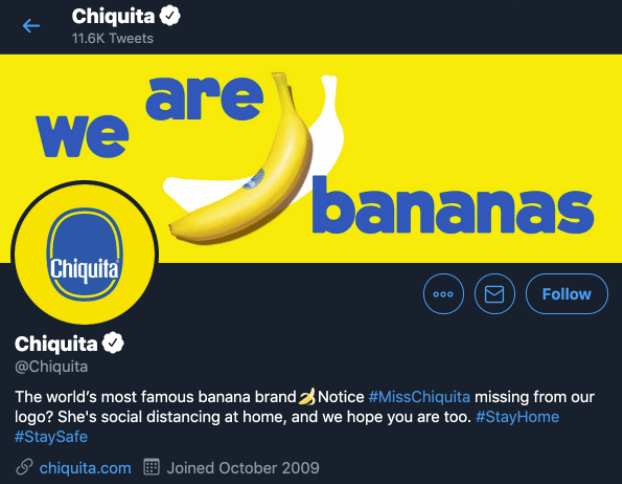
This is pretty self-explanatory. Our favorite example of a brand taking a minute to pause and re-orient comes from Chiquita banana. They did a great job of incorporating the #StayAtHome campaign while still maintaining their brand voice and identity.


6. Cite credible sources

Again, pretty self-explanatory. As a manager of a social media campaign, you’re responsible for providing information that is accurate and honest. Your audience trusts you to be providing valid information. In a crisis, bad information is not only irresponsible but it has the potential to damage your reputation. It may be tempting to share shocking statistics or a new update but do your due diligence in fact-checking and ensuring what you’re sharing is supported by data from reputable sources like government agencies or organizations.


7. Listen to your audience to stay informed

Monitor your content closely and be prepared to make adjustments based on how your audience responds. If you begin sharing about how your company is supporting relief efforts and your audience feels what you’re sharing is ill-timed, then it might be wise to pull that content and redirect towards something else.


8. Avoid jumping on the “trend train”

Don’t attempt to spin a crisis. Plain and simple, it won’t work and it will receive negative backlash. Now, that’s not to say that you can’t adapt to a new environment and rethink your business model to fit the situation. Recently, the factory that produced the uniforms for the Philadelphia Phillies was getting creative about what they could do with all the unused fabric they had laying around after the season was postponed. They decided to take that material and repurpose it for cloth face masks. There’s a national shortage and they felt it was their social responsibility to reallocate what they had to serve the greater good. This is a great example of how to take advantage of the situation without trying to spin it in your favor or appear profit-driven.


9. Make room for questions

People will have questions. It’s unavoidable. As situations become more tense and uneasy, your audience will become hyper-aware of your company and your product or service. They’ll ask incredibly specific questions that you may have never been asked for. Be prepared and don’t be offended. Remember that people are trying to navigate a new situation just like you are.


10. Don’t go off the grid

This is incredibly important. I know at the beginning we mentioned “pausing” your campaign. But this is a temporary measure in order to regroup and come back stronger. You may feel continuing a social media campaign is insensitive in light of the current climate, but that’s simply not true. Your audience is looking for dependency and certainty wherever they can get it. They want to see you stand your ground and stay strong. 


We know that crafting a social media campaign in the middle of a crisis is probably the last thing you’re thinking about or even want to be doing. You have a business to run, employees to take care of, and customers to support. That’s where we come in. Let us help you through this season and ensure you come out on the other side strong.

Social Media in a Time Like This

It’s a very strange time in the world right now. The current global crisis of COVID-19 has the world rocking and reeling. And rightfully so. Never before in my life have I seen something like this. Just today I went to order Thai food, temporarily spacing on the mandatory stay home order issue that has closed many businesses and restaurants. I was hit again with the painful reminder that there is a real crisis happening, right outside. And we are all in this together. 

We will make it through.

What does the current global climate mean for your social media? There has been a 70% increase in time spent across social platforms such as Instagram and Whatsapp, a 50% increase of messaging across Facebook’s platforms, and 2x more Facebook and Instagram Live views.

There have been 468 Million mentions of keywords related to the COVID-19 outbreak across social media channels over the past 90 days. That number is staggering. With 62% of adults in the U.S. getting their news from social media while 59% of consumers engage with their favorite brands on social media as well. And from a recent poll, 68% of people learned about company updates from social media, with 79% via email.

These numbers are pointing to one thing: People are turning to social media outlets now more than ever for information, connection, and so much more. Digital attention is drastically on the rise as people turn to social media to what we at The AD Leaf ® believe to be a more grass-roots resurgence of the whole point of social media: to be social. With many staying at home to protect the lives of others and themselves, social media has reminded us once again that it’s of vital importance as a tool to remain connected, to communicate ideas, or organize and collaborate, and see loved ones.

With that being said, there is something of vital importance to insert here. The current COVID-10 pandemic is not a marketing opportunity. 

With the state of the world, there are things that you need to consider as we all navigate into some pretty murky waters. Below are a few quick ideas that we think are vitally important for you, your brand, and social media:

  1. Be careful to not “go dark” – This is huge. It’s important to not just drop off the face of the planet, especially in a time like this. Your brand needs to be seen as a pillar of strength for your audience. What we would suggest is to pause your social media, take a step back, and reevaluate the direction of your strategy. What was communicated last week may very well not fit into the current narrative. It’s ok to take a step back for a few days to reassess the situation, the tone, your strategy, and your in-house staff. But then, once ready, come back as a source of strength and encouragement to others. Going dark for a long time communicates an instability that will hurt you in the long run. Keep the lights on.
  2. Don’t capitalize on the situation – We have never seen such a pandemic like this in our lifetime. This is not the time to try and hijack the situation for personal gain. Many don’t mean or realize that what they are communicating is actually insensitive, so take a moment to think about which foot you are stepping forward with. Make an extra emphasis on empathy, and approach the situation as someone who is here to help. That doesn’t mean however that you cannot sell products, but it does mean don’t use a painful situation to capitalize on. Be careful here.
  3. Tone – We touched on this, but the tone is huge here. Stay true to your brand during this time, but exercise balance. The livelihood of your team may depend on selling products, and that’s ok. But the way you go about things here requires more tact and balance than ever before. Think about staying true to yourself, but being more compassionate. As an additional note, it’s ok that your brand doesn’t have all the answers. Transparency coupled with professionalism is a bright, shining example that we have seen many companies exercise in the light of recent events.
  4. Communicate – Whether it’s with your team or your audience, it’s of paramount importance to over-communicate in this time. And if you are able, work from home to help reduce the spread of the virus. We have a plethora of ways to remain connected, like the video conference call company, ZOOM, to help you and your team remain on the same page. With your audience, it’s important to do the same and let them know what’s going on. As we saw earlier, a large percentage of people use social media for company updates, so once you have stepped back to reassess your direction, come forward with a clear message of hope, resilience, and on-brand messaging. A point of caution here would be to be careful to not communicate information that your audience may not need. There is a plethora of companies, brands, leaders, influencers, politicians, newsrooms, newspapers, authors, actors, and endlessly more voices out there, communicating information. Sending out that email to an inbox that has already received 54 emails before 9 am can add unnecessarily to stressors that are probably already occurring. Only send pertinent info. 
  5. Practice moderation – This one is a gentle reminder about mental health. It’s ok to not have all the answers. It’s equally ok to not be glued to social media or the news where the challenging events are constantly in your face. Our mindset can be greatly impacted by the onslaught of the terrible things that are happening out there and being viewed in real-time at our fingertips. Take this time home as an opportunity to spend additional time with your spouse, your kids, to pick up a hobby, or to go on a walk. Practice social distancing, but also unplug and take a moment to exercise gratitude. Science shows that those who practice being thankful are mentally and physically healthier and happier. Take a moment to smell the roses. 


While this is a serious event in human history, we have seen glimmers of hope and encouragement from regular businesses and people, just like you. For example, Krispy Kreme is giving away donuts to all health care workers. The CEO of Texas Roadhouse gives up their salary so front-line workers can get paid. Zoom has made video sharing services free for teachers so at-home classes can commence. Starbucks has extended mental health benefits to its partners. Apple is offering unlimited paid sick leave to any of its employees experiencing related symptoms. Sprint is giving its customers unlimited data and 20G of hotspot access for 60 days to ease remote working. And the list goes on!

We at The AD Leaf ® want you to know that if there is any way we can help you, please reach out to us. We are here for you. 


Resources:

https://buffer.com/resources/social-media-management-in-times-of-crisis

https://www.forbes.com/sites/amymorin/2014/11/23/7-scientifically-proven-benefits-of-gratitude-that-will-motivate-you-to-give-thanks-year-round/#6f75c197183c

https://www.forbes.com/sites/blakemorgan/2020/03/17/50-ways-companies-are-giving-back-during-the-corona-pandemic/#4cb944dd4723

The Fine Line of Social Media

During times of national emergency, or in this case, global, companies need to walk the fine line of continuing with business as usual while being sensitive to the problem at hand. Companies and individuals alike are going through a scary, uncertain time. During times of uncertainty, people turn to what is secure. It may seem minor, but a sensitive and robust message on social media from brands does help provide a sense of normalcy. It’s a gut reaction for many companies to pull back on social media marketing and advertising but is that the right call? To be frank, no. Let’s talk about some common concerns and how to confront them.

Continue reading

Digital Marketing Strategy

Why Businesses Need Digital Marketing To Survive COVID-19

Why Businesses Need A Digital Marketing Strategy To Survive COVID-19

In the coming months, businesses of all sizes are going to become extra reliant than ever on their digital marketing strategy. Without wanting to sound too much like a killjoy, in many cases, it will be the deciding factor in whether they make it through the tough times that are ahead. 

The unparalleled, and almost-total disappearance of all channels related to live events and conferences, and the increasing barriers on face-to-face business, pose an enormous challenge to any business model. 

B2B companies, in particular, rely on the annual circuit of trade shows and exhibitions to network and build customer relations. In industries that are not digital-native, they may also be less sophisticated in their digital growth and customer relations strategies. Especially in the case of smaller businesses that are used to getting new customers strictly word-of-mouth referrals or on the strength of a hard-won reputation, their loss is going to come as a shock if it hasn’t already.

Larger companies are now finding themselves in the position of having potentially lost millions of dollars from canceled events alone. They won’t claw back the hours of time and expense spent on preparations for this year, but insurance and flexible cancellation policies are going to leave them with some marketing budget to reassign. Digital Marketing in any aspect is likely going to be the clear and obvious choice here, and companies that may not so much as had a Facebook page before will need to move into social media marketing, content marketing, SEO, and even influencer-led campaigns. 

This, of course, means there are opportunities out there for the taking and a key factor in resilience is adaptability. If it’s standard in your industry to go out and meet new customers face-to-face before you do business, adapting may mean opening new channels over web or social media platforms where introductions can be made and relationship fostered. In the coming months, you prospective clients are going to be less open to the idea of letting you walk through the door and shake their hand, and no-one really has any idea how long this will last and whether this will lead to longer-term change. 

We are going to be in some uncertain times, but with the increase of remote working and a collaborative approach, companies are going to turn to digital channels and embrace the transformation. There has already been a real spike in the last few weeks from companies wishing to create or update their websites, launch new social media channels and campaigns focused on home-workers and a real focus on using influencers and SEO to reach new audiences. 

Being confined to the office — or even the home — rather than on the road on sales visits or at events, means marketers are going to have more time to develop digital marketing strategies. This means researching where your customers can be found online, and how different approaches and tactics might impact your success. If your organization previously put minimal efforts into digital channels, now is going to be a prime time to revisit them. That could be as simple as giving your website or social media pages a refresh, or a more innovative approach. 

A key point to note is that a lot of corporate entities use up about 50-60% of their marketing budgets on events. When things go back to normal, budgets will most likely be going back to those live face-to-face events, but if organizations can see the benefits and opportunities that digital marketing can offer, they might understand the benefit of adding it to their long-term marketing strategy. 

Channels such as Facebook, Instagram, or LinkedIn Live are going to be crucial moving forward as the ability to connect with a targeted audience real-time is very beneficial, if not essential. 

It’s certainly true that the coming weeks, or months – or however long this situation lasts – will be a challenging time for any company that isn’t ready to think about how they will replace the opportunities that have been lost. 

As long as businesses can approach the shift to digital marketing strategically, there’s no reason why it should just serve as an emergency fill-in but could carry on providing long-term value when the world eventually gets back to normal. And of course, this would make companies more resilient to deal with any future pandemics. Do you need help with your Digital Marketing Strategy? Looking to take your social media or SEO to the next step? Contact the team at The AD Leaf ® Marketing Firm and learn how you can grow with us today and weather the storm that is COVID-19!

How Has Social Media Impacted The Corona Virus?

Going from an Epidemic to a Pandemic, the Coronavirus is sweeping news headlines and social media across the world. What started as an unknown illness at the beginning of 2020 has turned into a global pandemic with many companies, schools, and organizations taking action to prevent the spread of the disease. While there have been disease outbreaks such as the Avian flu, Swine flu, and others, no disease has been quite like the coronavirus. If you’ve been on social media within the last month you have most likely seen news updates, company updates, and memes all revolving around the virus. It is clear that social media has played a key role in the panic and news updates involving the virus.

How have companies addressed it?

Many companies have used social media as their biggest communication platform to address the virus. Companies such as Planet Fitness, Comfort Inn, and multiple restaurant chains are using social media to address the extra safety measures they are taking in order to prevent the spread of the virus and keep everything sanitary. Many companies have taken extra safety measures with their employees by having them work remotely from home, with some businesses even closing temporarily to prevent the spread of the virus. Companies now have to make the tough choice of losing profit and business by taking costly safety measures to stay safe or risk losing the trust of the public and employees by not taking proper safety measures. This can be clearly seen on social media as companies who are posting in regards to the virus are getting mixed reactions from those who believe the virus is being blown out of proportion, to those who don’t think some companies are taking safety seriously enough. It seems that there will be backlash regardless of which stance the company takes regarding the virus. Now, Public Relations workers are being challenged with the tough tasks of deciding how their company will handle the coronavirus.

How have people addressed it?

Social media has also been the biggest communication platform for personal reactions and opinions regarding the coronavirus. While many have used it to share news articles and updates regarding the virus, some have shared and created fake news which has helped play into the panic involving the virus, and exaggerates its symptoms. This has resulted in many people taking unnecessary actions such as stockpiling toilet paper, hand sanitizer, and other cleaning supplies creating a shortage across the country. Some people have also reacted very poorly to the virus regarding school and business closing announcements on social media with some students going as far as rioting. According to the New York Post on March 11th after classes were suspended at the University of Dayton in Ohio due to the coronavirus, many students began rioting at the campus with over “1,000 students gathered on Lowes Street starting around 11 p.m., throwing objects and bottles in the street and at police, and jumping on cars,” the school said in a statement. Other events such as concerts, music festivals and sports events have also been canceled with many fans angrily reacting on social media. On the bright side, not all social media involving the coronavirus has been negative. Some users have taken to social media in a more humorous approach regarding the virus posting funny memes as well as many celebrating the discounted prices of cruise lines and flights. Some users have also offered to help anyone with coronavirus and shared ways on how to prevent the coronavirus such as proper handwashing techniques, and ways to stay safe.

Misinformation and false posts

While social media can be a great source of information and news regarding the coronavirus, it can also be misinformative, overexaggerated or completely false. When reading articles make sure that it is accurate by using fact-checkers and your own judgment. A great free fact-checker that you can use is factcheck.org. This fact-checker can help you find false or partially false information to help you find reputable sources as well as avoid using inaccurate information and articles. Another important thing is to make sure of is that the article or news is from a trusted and credible news source before you share it yourself. A helpful tip is to look for news articles that come from sites that end in .edu or .gov as they are always credible sources from the government or universities. Facebook has also been tightening its grip on false news and information articles to stop the spread of panic and misinformation. Facebook now flags false articles and posts with their own fact-checkers but that doesn’t mean that it is able to detect all misinformation and fake news. Keep this in mind as you scroll through your newsfeed what measures businesses are taking to keep everyone safe and also be aware of the information that everyone else is posting in social media so you can make the best judgment calls regarding the virus.